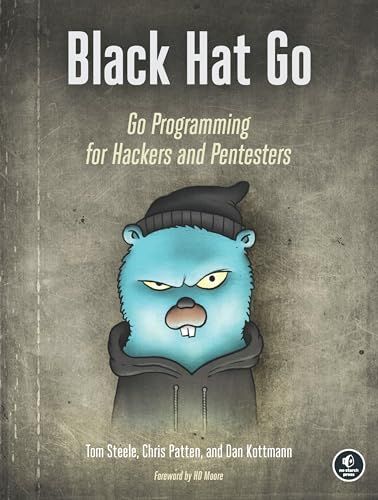
Black Hat Go
Go Programming For Hackers and Pentesters
Tom Steele, Chris Patten, and Dan Kottmann show how to use Go's networking primitives, concurrency model, and cross-compilation to write offensive tooling that runs almost anywhere.
As an Amazon Associate we earn from qualifying purchases. The link above is sponsored.
- Authors
- Tom Steele,Chris Patten,Dan Kottmann
- Published
- 2020
- Publisher
- No Starch Press
- Pages
- 368
- Language
- English
Read this if
Offensive practitioners who already know Python (or Bash) and want a compiled-language alternative for tools that need to run as a single binary on locked-down endpoints. Go's cross-compilation and tiny runtime make it the right choice for many implant-style tools.
Skip this if
Beginners with no programming background. The book assumes Go familiarity at the syntax level; for the language itself, read The Go Programming Language (Donovan/Kernighan) first.
Key takeaways
- Go binaries cross-compile to Windows, Linux, macOS, and ARM with no toolchain pain; for offensive tools that need to land on a target, Go saves hours.
- Concurrency in Go is simple enough that scanners, brute forcers, and watchdog tools become trivial to write; the book's networking chapters lean on this.
- Modern offensive tooling (Cobalt Strike alternatives, Mythic agents, Sliver) is increasingly Go-native; reading this book is reading the language those projects share.
Notes
Pair with Black Hat Python (Seitz/Arnold) for the Python complement and with the Sliver / Mythic / Havoc source code for the modern tooling examples. The book's chapters on networking, command-and-control patterns, and Windows-specific syscalls are the practical core. Go's standard library does most of the work; the book teaches you how to leverage it.
What to read before
What to read before Black Hat Go →Intermediate · 2021
Black Hat Python
Justin Seitz and Tim Arnold's hands-on tour of writing offensive tooling in Python: network sniffers, web scrapers, GitHub-based command-and-control, screen capture, keylogging, and Volatility extensions.
Beginner · 2009
Nmap Network Scanning
Written by Nmap's own author, this is both a gentle introduction to port scanning and the definitive reference for every flag, timing knob, and NSE script the tool ships with.
Beginner · 2014
Penetration Testing
Georgia Weidman's lab-driven introduction to pentesting, walking the reader from setting up a target environment through scanning, exploitation, post-exploitation, and reporting.
What to read next
What to read after Black Hat Go →Intermediate · 2021
Black Hat Python
Justin Seitz and Tim Arnold's hands-on tour of writing offensive tooling in Python: network sniffers, web scrapers, GitHub-based command-and-control, screen capture, keylogging, and Volatility extensions.
Advanced · 2017
Attacking Network Protocols
James Forshaw, Project Zero veteran, on how to capture, parse, and break protocols from the wire up to the application layer, with a strong focus on building reusable analysis tooling.
Intermediate · 2008
Hacking: The Art of Exploitation
A from-first-principles tour of low-level exploitation that still teaches the mindset two decades later.
Explore similar books
Alternatives to Black Hat Go →Intermediate · 2021
Black Hat Python
Justin Seitz and Tim Arnold's hands-on tour of writing offensive tooling in Python: network sniffers, web scrapers, GitHub-based command-and-control, screen capture, keylogging, and Volatility extensions.
Intermediate · 2025
Metasploit
The second edition of the definitive No Starch guide to the Metasploit Framework, updated by the project's original maintainers and newer contributors for the modern Framework.
Intermediate · 2024
Black Hat Bash
Nick Aleks and Dolev Farhi on getting offensive work done with the shell: privilege escalation tooling, lateral movement, and pipelining bash with the rest of the toolkit.