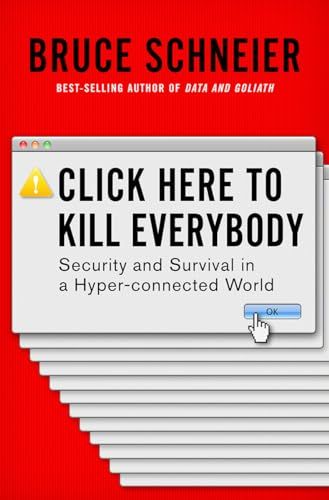
Click Here to Kill Everybody
Security and Survival in a Hyper-Connected World
Bruce Schneier's policy-level argument that as everything becomes a computer (cars, medical devices, infrastructure, voting), the security failures that used to merely cost us money will start costing lives — and the regulatory shape of that future is being decided now.
As an Amazon Associate we earn from qualifying purchases. The link above is sponsored.
- Authors
- Bruce Schneier
- Published
- 2018
- Publisher
- W. W. Norton & Company
- Pages
- 320
- Language
- English
Read this if
Engineers, policy people, and managers who need to brief leadership on why IoT, OT, and cyber-physical systems are categorically different from the IT security they grew up with. Also the right first Schneier book for anyone newly responsible for cyber-physical risk.
Skip this if
Readers wanting hands-on IoT-hacking technique; for that, Practical IoT Hacking (Chantzis et al.) and The Hardware Hacking Handbook are the references. Also dated on specific 2018 examples even though the structural arguments hold.
Key takeaways
- Internet+ — Schneier's term for cyber-physical convergence — changes the consequences of security failure, not just the surface.
- Markets won't fix this; the book's policy argument is that liability, regulation, and procurement standards are the only working levers.
- Engineering culture and policy culture talk past each other; the book is a useful Rosetta stone in both directions.
Notes
Pair with Security Engineering 3e (Anderson) for the engineering substrate and with The Hacker and the State (Buchanan) for the geopolitical layer. Schneier's blog and Crypto-Gram newsletter are the ongoing companion — most chapters here are essays from there, refined and structured. The most quotable Schneier book and a useful gift to non-technical stakeholders who need to understand why this is different from anti-virus.
What to read before
What to read before Click Here to Kill Everybody →Beginner · 2015
La cybersécurité
A pocket-sized primer on cybersecurity as a societal and geopolitical issue — threats, actors, stakes and policy — in the classic French “Que sais-je ?” format.
Beginner · 2019
Foundations of Information Security
Jason Andress' compact tour of the field: confidentiality / integrity / availability, identification and authentication, network and OS controls, written for newcomers and adjacent disciplines.
Beginner · 2021
How Cybersecurity Really Works
Sam Grubb's gentle, exercise-driven introduction for non-specialists who need a working mental model of attacker behaviour and basic defence.
What to read next
What to read after Click Here to Kill Everybody →Intermediate · 2023
Cybercriminalité
Solange Ghernaouti's structured treatment of cybercrime — how it works, how to prevent it, how to respond — spanning technical, legal and organisational angles.
Intermediate · 2005
Reversing
The book that taught a generation how software actually looks once you strip away the source. Still the clearest on-ramp to thinking in assembly, even with dated tools.
Intermediate · 2018
Social Engineering
Christopher Hadnagy's broad procedural reference on social engineering as a discipline — recon, pretexting, elicitation, microexpressions, and the structured engagement model his consultancy operationalized.
Explore similar books
Alternatives to Click Here to Kill Everybody →Beginner · 2015
La cybersécurité
A pocket-sized primer on cybersecurity as a societal and geopolitical issue — threats, actors, stakes and policy — in the classic French “Que sais-je ?” format.
Beginner · 2021
How Cybersecurity Really Works
Sam Grubb's gentle, exercise-driven introduction for non-specialists who need a working mental model of attacker behaviour and basic defence.
Beginner · 2019
Foundations of Information Security
Jason Andress' compact tour of the field: confidentiality / integrity / availability, identification and authentication, network and OS controls, written for newcomers and adjacent disciplines.