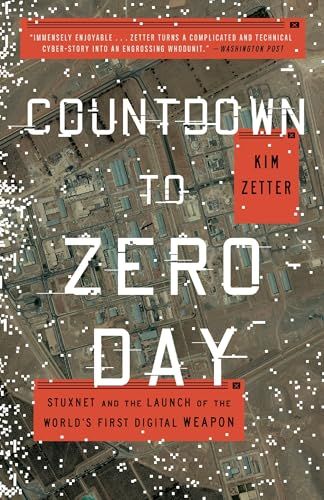
Countdown to Zero Day
Stuxnet and the Launch of the World's First Digital Weapon
Kim Zetter's investigative reconstruction of Stuxnet, the joint US/Israeli operation that physically damaged Iranian uranium-enrichment centrifuges via a worm, and what its discovery revealed about state-level cyber capability.
As an Amazon Associate we earn from qualifying purchases. The link above is sponsored.
- Authors
- Kim Zetter
- Published
- 2014
- Publisher
- Crown
- Pages
- 433
- Language
- English
Read this if
Anyone who wants to understand what a real nation-state cyber operation looks like end-to-end: scoping, target intelligence, payload engineering, deployment, and the inevitable discovery. The definitive Stuxnet narrative.
Skip this if
Readers wanting line-by-line malware analysis. Zetter is a journalist, not a reverse engineer; the technical depth is operational and policy-level. Pair with Aleksandr Matrosov's writeups or with the original Symantec / Kaspersky technical reports if you want the binary view.
Key takeaways
- Stuxnet was a campaign with multiple variants and years of preparation, not a single payload; the patience involved is the operational lesson.
- Air-gapped doesn't mean unreachable; supply chain and human movement are the path.
- Once a capability is used, it's studied and replicated; the strategic cost of using cyber weapons is paid later, by everyone.
Notes
Best paired with Sandworm (Greenberg) for the GRU continuity, with Zero Days (Gibney's documentary) for the operational view, and with This Is How They Tell Me the World Ends (Perlroth) for the zero-day market context. Zetter's Wired reporting is the original primary source; the book consolidates and extends it. Required reading for anyone who confuses "cyber weapon" with "vulnerability".
What to read before
What to read before Countdown to Zero Day →Beginner · 2019
Sandworm
Long-form journalism on the GRU's hacking operations, the best non-technical book on what state-level cyber actually looks like.
Beginner · 2020
The Hacker and the State
Ben Buchanan's argument that state-on-state cyber operations are not deterrence-shaped (like nuclear) but signaling-shaped: countries use cyber to shape the environment, not to threaten escalation. Builds the case from declassified incidents.
Beginner · 2014
@War
Shane Harris on the entanglement of US military doctrine, the intelligence community, and private contractors after cyberspace was declared the fifth warfighting domain.
What to read next
What to read after Countdown to Zero Day →Intermediate · 2018
Cyber
A strategic analysis of cyber conflict as permanent, sub-threshold warfare — and what France and Europe should do about it — by a former senior French strategist and a consultant.
Intermediate · 2012
Cyberstratégie
An early French military-strategic treatment of cyberspace as a theatre of operations — doctrine, deterrence and the determinants of a national cyber policy — by a French officer and strategist.
Intermediate · 2014
Cybertactique
The tactical companion to Cyberstratégie — how cyber operations are actually conducted, from planning to execution — by a French officer and strategist.
Explore similar books
Alternatives to Countdown to Zero Day →Intermediate · 2018
Cyber
A strategic analysis of cyber conflict as permanent, sub-threshold warfare — and what France and Europe should do about it — by a former senior French strategist and a consultant.
Intermediate · 2015
Introduction à la cyberstratégie
A foundational French introduction to cyberstrategy — treating cyberspace as a domain of strategic thought — by a former officer and strategy scholar.
Intermediate · 2014
Cybertactique
The tactical companion to Cyberstratégie — how cyber operations are actually conducted, from planning to execution — by a French officer and strategist.