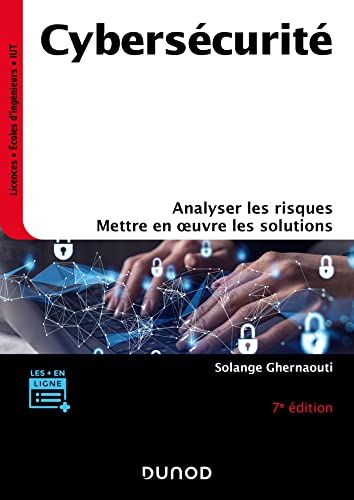
Cybersécurité
Analyser les risques, mettre en œuvre les solutions · 7e édition
Solange Ghernaouti's broad academic survey of cybersecurity — risk analysis, governance, technical and legal dimensions — the standard French university reference, now in its 7th edition.
As an Amazon Associate we earn from qualifying purchases. The link above is sponsored.
- Authors
- Solange Ghernaouti
- Published
- 2022
- Publisher
- Dunod
- Pages
- 384
- Edition
- 7e édition
- Language
- French
Read this if
Students, managers and RSSI who need the whole landscape: risk, governance, legal, organisational and technical defence in one structured textbook. Strong on the managerial and risk-analysis side that purely technical books skip.
Skip this if
Hands-on practitioners looking for attacks, tooling or labs. This is a survey and risk-management text, not a technical how-to; it explains the field rather than teaching you to break or build.
Key takeaways
- The reference French academic textbook on cybersecurity, regularly updated — useful precisely because it's broad and structured rather than deep.
- Its strength is risk analysis and governance: how to frame, measure and organise security, not how to exploit a target.
- Better as a course backbone or a manager's orientation than as a practitioner's bench reference.
Notes
The book most French cybersecurity degrees assign first. Read it for the structured overview and the risk/governance framing; pair it with a hands-on title like the ACISSI Ethical Hacking book for the offensive side it deliberately leaves out.
What to read before
What to read before Cybersécurité →Beginner · 2019
Foundations of Information Security
Jason Andress' compact tour of the field: confidentiality / integrity / availability, identification and authentication, network and OS controls, written for newcomers and adjacent disciplines.
Beginner · 2021
How Cybersecurity Really Works
Sam Grubb's gentle, exercise-driven introduction for non-specialists who need a working mental model of attacker behaviour and basic defence.
Beginner · 2021
Cyberjutsu
Ben McCarty maps declassified medieval ninja scrolls onto modern adversary tradecraft. More analogy-driven than technical, useful for security-program framing.
What to read next
What to read after Cybersécurité →Advanced · 2013
Sécurité informatique
A principles-first treatment of information security for DSI, RSSI and sysadmins — architecture, cryptography, network defence and security policy — from two veteran French practitioners.
Advanced · 2020
Intelligence artificielle, cybersécurité et cyberdéfense
An academic examination of how artificial intelligence reshapes cybersecurity and cyberdefence — opportunities, threats and strategic implications — by France's most prolific cyberwar scholar.
Advanced · 2015
Sécurité informatique
A rigorous academic course on the foundations of security — cryptography, authentication, access control — with corrected exercises, from a team of well-known French and Swiss cryptographers.
Explore similar books
Alternatives to Cybersécurité →Beginner · 2021
How Cybersecurity Really Works
Sam Grubb's gentle, exercise-driven introduction for non-specialists who need a working mental model of attacker behaviour and basic defence.
Beginner · 2019
Foundations of Information Security
Jason Andress' compact tour of the field: confidentiality / integrity / availability, identification and authentication, network and OS controls, written for newcomers and adjacent disciplines.
Intermediate · 2018
Social Engineering
Christopher Hadnagy's broad procedural reference on social engineering as a discipline — recon, pretexting, elicitation, microexpressions, and the structured engagement model his consultancy operationalized.