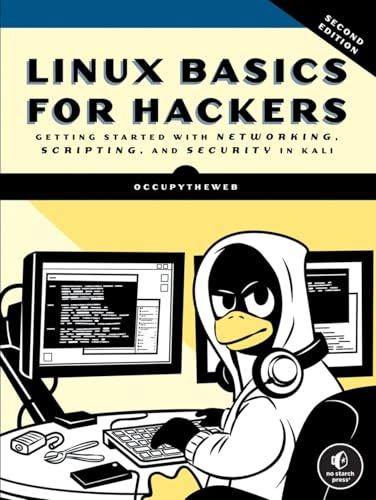
Linux Basics for Hackers
Getting Started with Networking, Scripting, and Security in Kali
OccupyTheWeb's introduction to Linux from the angle that hackers and pentesters actually need it: shells, networking, scripting, and Kali tooling.
As an Amazon Associate we earn from qualifying purchases. The link above is sponsored.
- Authors
- OccupyTheWeb
- Published
- 2025
- Publisher
- No Starch Press
- Pages
- 264
- Language
- English
Read this if
Beginners with no Linux background who need just enough fluency to follow security tutorials, run security tools, and not get lost. Required prerequisite for most pentest, OSCP, and CTF starting paths.
Skip this if
Anyone who already uses Linux daily. The book is intentionally introductory; experienced users will find every chapter familiar.
Key takeaways
- Linux fluency for security work is a small, finite skill: shell, file ops, services, networking commands, basic scripting. The book covers exactly that and nothing more.
- Type every command. The book is muscle-memory training disguised as a reference; passive reading wastes the time.
- Kali is a defaults-and-tooling distro, not a different OS; understanding base Linux means you'll never be confused when the tool isn't pre-installed.
Notes
Pair with Penetration Testing (Weidman) for the workflow context and PortSwigger Academy for the web complement. The 2nd edition (2025) refreshes commands and tooling for current Kali / Debian; if you're shopping, get this edition. OccupyTheWeb's blog (Hackers-Arise) has continuing material in the same style.
What to read before
What to read before Linux Basics for Hackers →Beginner · 2019
Foundations of Information Security
Jason Andress' compact tour of the field: confidentiality / integrity / availability, identification and authentication, network and OS controls, written for newcomers and adjacent disciplines.
Beginner · 2021
How Cybersecurity Really Works
Sam Grubb's gentle, exercise-driven introduction for non-specialists who need a working mental model of attacker behaviour and basic defence.
Beginner · 2019
The Pragmatic Programmer
Thomas and Hunt's career-defining set of practical heuristics for writing software professionally — orthogonality, broken-windows, DRY, tracer bullets, and the underlying argument that craftsmanship is a posture, not a process.
What to read next
What to read after Linux Basics for Hackers →Intermediate · 2022
Sécurité informatique - Ethical Hacking
The French-language reference for offensive security: a thick, lab-heavy tour of the attacker's toolkit, maintained across editions by the ACISSI collective under the motto “learn the attack to better defend.”
Intermediate · 2005
Reversing
The book that taught a generation how software actually looks once you strip away the source. Still the clearest on-ramp to thinking in assembly, even with dated tools.
Intermediate · 2018
Social Engineering
Christopher Hadnagy's broad procedural reference on social engineering as a discipline — recon, pretexting, elicitation, microexpressions, and the structured engagement model his consultancy operationalized.
Explore similar books
Alternatives to Linux Basics for Hackers →Beginner · 2021
How Cybersecurity Really Works
Sam Grubb's gentle, exercise-driven introduction for non-specialists who need a working mental model of attacker behaviour and basic defence.
Beginner · 2019
Foundations of Information Security
Jason Andress' compact tour of the field: confidentiality / integrity / availability, identification and authentication, network and OS controls, written for newcomers and adjacent disciplines.
Intermediate · 2022
Sécurité informatique - Ethical Hacking
The French-language reference for offensive security: a thick, lab-heavy tour of the attacker's toolkit, maintained across editions by the ACISSI collective under the motto “learn the attack to better defend.”