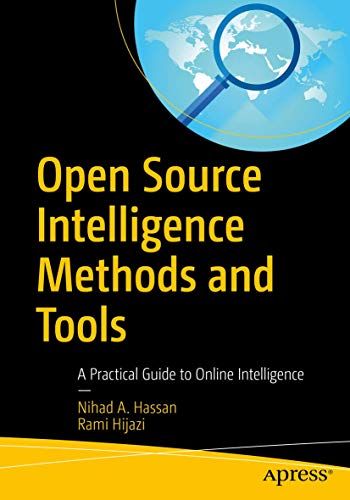
Open Source Intelligence Techniques and Tools
Hassan and Hijazi's pedagogical introduction to OSINT framed inside the broader intelligence cycle (collection → processing → analysis → dissemination) rather than around a specific toolchain.
As an Amazon Associate we earn from qualifying purchases. The link above is sponsored.
- Authors
- Nihad A. Hassan,Rami Hijazi
- Published
- 2018
- Publisher
- Apress
- Pages
- 354
- Language
- English
Read this if
Readers coming from a non-investigative background — students, analysts, junior threat-intel hires — who want a methodology before they touch tools. Stronger on framing and process than Bazzell, and the right first book if you don't yet know what an OSINT engagement should produce.
Skip this if
Practitioners who already know the methodology and need current tooling; this book ages quickly on URLs and platforms. Also light on OPSEC, attribution avoidance, and the operational rigour real investigations demand. By 2026 the tooling chapters are partially historical.
Key takeaways
- OSINT lives inside the intelligence cycle; treating it as ad-hoc Googling produces ad-hoc Googling-grade output.
- Source classification, bias awareness, and verification are the boring chapters that separate analysis from speculation.
- Hassan and Hijazi's strongest contribution is the conceptual scaffolding; once internalized, you can graduate to Bazzell for current depth.
Notes
Use it as a stepping stone to OSINT Techniques 11e (Bazzell), not as a substitute. Pair with Tracers in the Dark (Greenberg) for a real investigation that exercises every stage of the cycle. The book's strength is teaching you to ask the right questions; once you can, the tools you reach for change every quarter and that's fine.
What to read before
What to read before Open Source Intelligence Techniques and Tools →Beginner · 2017
American Kingpin
A propulsive account of how Ross Ulbricht built the Silk Road dark-web drug empire as Dread Pirate Roberts, and how a handful of investigators across rival agencies finally unmasked him.
Intermediate · 2024
OSINT Techniques
Michael Bazzell's relentlessly updated technical manual for finding people, accounts, breach data, geolocation evidence, and online identifiers — the de facto reference of the modern OSINT field.
Beginner · 2022
Tracers in the Dark
Andy Greenberg's investigative narrative of how Bitcoin's allegedly-anonymous public ledger became, in the hands of researchers and federal investigators, the most powerful OSINT tool of the last decade.
What to read next
What to read after Open Source Intelligence Techniques and Tools →Intermediate · 2024
OSINT Techniques
Michael Bazzell's relentlessly updated technical manual for finding people, accounts, breach data, geolocation evidence, and online identifiers — the de facto reference of the modern OSINT field.
Intermediate · 2024
Extreme Privacy
Michael Bazzell's defender-side companion to OSINT Techniques: a step-by-step program for removing yourself from data brokers, public records, and the everyday surveillance economy without going off-grid.
Intermediate · 2022
Practical Social Engineering
Joe Gray's working manual for the social-engineering side of red team and threat intel: OSINT-driven recon, pretexting, phishing infrastructure, and the legal and ethical boundaries that separate professional work from criminal activity.
Explore similar books
Alternatives to Open Source Intelligence Techniques and Tools →Intermediate · 2024
OSINT Techniques
Michael Bazzell's relentlessly updated technical manual for finding people, accounts, breach data, geolocation evidence, and online identifiers — the de facto reference of the modern OSINT field.
Beginner · 2022
Tracers in the Dark
Andy Greenberg's investigative narrative of how Bitcoin's allegedly-anonymous public ledger became, in the hands of researchers and federal investigators, the most powerful OSINT tool of the last decade.
Beginner · 2017
American Kingpin
A propulsive account of how Ross Ulbricht built the Silk Road dark-web drug empire as Dread Pirate Roberts, and how a handful of investigators across rival agencies finally unmasked him.