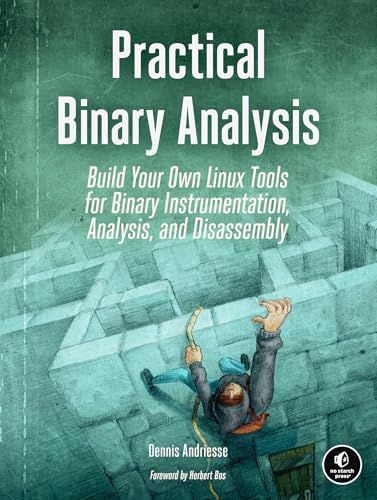
Practical Binary Analysis
Build Your Own Linux Tools for Binary Instrumentation, Analysis, and Disassembly
Dennis Andriesse on the binary toolchain you can actually script: ELF internals, dynamic taint analysis, symbolic execution and instrumentation with concrete code-along examples.
As an Amazon Associate we earn from qualifying purchases. The link above is sponsored.
- Authors
- Dennis Andriesse
- Published
- 2018
- Publisher
- No Starch Press
- Pages
- 456
- Language
- English
Read this if
Reverse engineers ready to stop being IDA clickers and start being programmers who happen to RE. Andriesse covers DBI (Pin), taint analysis (Triton), and symbolic execution (angr) at exactly the level a practitioner needs to weaponize them.
Skip this if
RE beginners who haven't yet finished Practical Reverse Engineering, or readers without C and Python comfort. The book assumes you can already disassemble; the value is in the automation layer.
Key takeaways
- Modern RE is automated RE; the book is the bridge between hand-driven analysis and the toolchain that scales to large binaries.
- Symbolic execution is finally accessible to working RE engineers thanks to angr, and Andriesse's framing is what makes it click for most practitioners.
- Custom DBI passes solve a category of problems that no GUI tool can; the book teaches you when to reach for them and how to write them.
Notes
Pair with Practical Reverse Engineering (Dang/Gazet/Bachaalany) for the architecture foundations and with The IDA Pro Book for the GUI workflow. Andriesse's research at VU Amsterdam and his angr-related papers are the natural follow-ups. The book assumes Linux; Windows readers can substitute Frida and DynamoRIO with minor friction.
What to read before
What to read before Practical Binary Analysis →Intermediate · 2020
The Ghidra Book
The reference manual for the NSA's open-source disassembler, written by the author of The IDA Pro Book. Exhaustive on the tool, thinner on the craft of reversing itself.
Intermediate · 2011
The IDA Pro Book
Chris Eagle's deep manual on IDA Pro, the disassembler that defined a generation of reverse engineering. Useful even with Ghidra in the picture, since most malware-analysis literature still assumes IDA.
Intermediate · 2005
Reversing
The book that taught a generation how software actually looks once you strip away the source. Still the clearest on-ramp to thinking in assembly, even with dated tools.
What to read next
What to read after Practical Binary Analysis →Intermediate · 2020
The Ghidra Book
The reference manual for the NSA's open-source disassembler, written by the author of The IDA Pro Book. Exhaustive on the tool, thinner on the craft of reversing itself.
Intermediate · 2011
The IDA Pro Book
Chris Eagle's deep manual on IDA Pro, the disassembler that defined a generation of reverse engineering. Useful even with Ghidra in the picture, since most malware-analysis literature still assumes IDA.
Advanced · 2021
The Hardware Hacking Handbook
Jasper van Woudenberg and Colin O'Flynn (NewAE / ChipWhisperer) on real hardware attacks: bus sniffing, fault injection, side-channel power analysis, and the lab work that turns a black box into a known target.
Explore similar books
Alternatives to Practical Binary Analysis →Intermediate · 2020
The Ghidra Book
The reference manual for the NSA's open-source disassembler, written by the author of The IDA Pro Book. Exhaustive on the tool, thinner on the craft of reversing itself.
Intermediate · 2011
The IDA Pro Book
Chris Eagle's deep manual on IDA Pro, the disassembler that defined a generation of reverse engineering. Useful even with Ghidra in the picture, since most malware-analysis literature still assumes IDA.
Advanced · 2021
The Hardware Hacking Handbook
Jasper van Woudenberg and Colin O'Flynn (NewAE / ChipWhisperer) on real hardware attacks: bus sniffing, fault injection, side-channel power analysis, and the lab work that turns a black box into a known target.