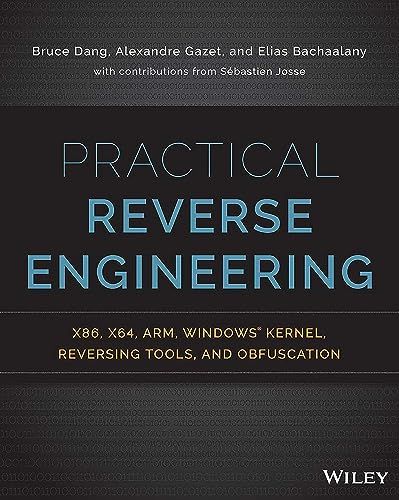
Practical Reverse Engineering
x86, x64, ARM, Windows Kernel, Reversing Tools, and Obfuscation
A working reverser's textbook from three Microsoft / Quarkslab veterans, covering the architectures and toolchain you'll actually meet on real targets, including the Windows kernel and modern obfuscation patterns.
As an Amazon Associate we earn from qualifying purchases. The link above is sponsored.
- Published
- 2014
- Publisher
- Wiley
- Pages
- 384
- Language
- English
Read this if
Reverse engineers transitioning from "I can read disassembly" to "I can audit a Windows kernel driver." The architecture-first companion to Practical Malware Analysis.
Skip this if
Beginners with no assembly background, or readers focused exclusively on Linux/userland. The book is heavy on Windows internals and assumes you'll do the exercises in WinDbg.
Key takeaways
- x86, x64, ARM, kernel-mode debugging, and anti-RE techniques in a single coherent volume; nothing else competes for breadth.
- The kernel debugging chapters are the practical introduction the official Windows Internals book never quite delivers for security audiences.
- Anti-RE coverage (obfuscation, packing, anti-debug, virtualization-based protection) is the bridge to modern malware analysis that PMA consciously skips.
Notes
Best read alongside Practical Malware Analysis (PMA covers Windows malware techniques; PRE covers what's underneath). Pair with Windows Internals 7e for systems-level depth and with Practical Binary Analysis (Andriesse) for the modern dynamic-analysis layer. The exercises are the book; skipping them turns a great training course into expensive wallpaper.
What to read before
What to read before Practical Reverse Engineering →Advanced · 2019
Rootkits and Bootkits
Matrosov, Rodionov and Bratus on persistent, deeply-embedded malware: kernel rootkits, MBR/UEFI bootkits, and the forensic techniques that surface them. Strongly Windows-internals oriented.
Intermediate · 2012
Practical Malware Analysis
Still the gold standard textbook for static and dynamic malware analysis on Windows.
Intermediate · 2005
Reversing
The book that taught a generation how software actually looks once you strip away the source. Still the clearest on-ramp to thinking in assembly, even with dated tools.
What to read next
What to read after Practical Reverse Engineering →Advanced · 2019
Rootkits and Bootkits
Matrosov, Rodionov and Bratus on persistent, deeply-embedded malware: kernel rootkits, MBR/UEFI bootkits, and the forensic techniques that surface them. Strongly Windows-internals oriented.
Advanced · 2024
Evasive Malware
Kyle Cucci on the anti-analysis arms race: sandbox detection, anti-debug, anti-VM, packing, and the analyst-side tooling and tradecraft that get past those layers.
Advanced · 2009
Les virus informatiques
The reference French academic treatment of computer virology — the theory, algorithms and practice of viruses and malicious code — by Éric Filiol, a former military cryptanalyst and one of France's leading virologists.
Explore similar books
Alternatives to Practical Reverse Engineering →Advanced · 2019
Rootkits and Bootkits
Matrosov, Rodionov and Bratus on persistent, deeply-embedded malware: kernel rootkits, MBR/UEFI bootkits, and the forensic techniques that surface them. Strongly Windows-internals oriented.
Advanced · 2024
Evasive Malware
Kyle Cucci on the anti-analysis arms race: sandbox detection, anti-debug, anti-VM, packing, and the analyst-side tooling and tradecraft that get past those layers.
Advanced · 2022
The Art of Mac Malware, Volume 1
Patrick Wardle's deep dive on macOS malware analysis: persistence patterns, injection techniques, anti-analysis tricks, and the macOS-specific tooling needed to triage real samples.