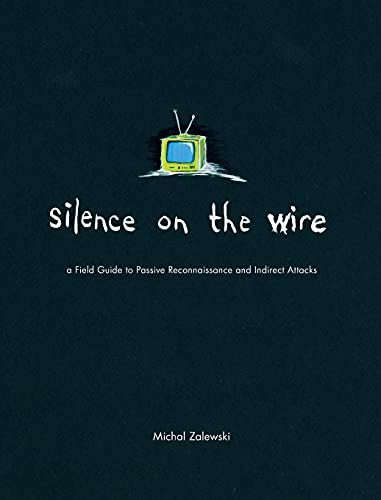
Silence on the Wire
A Field Guide to Passive Reconnaissance and Indirect Attacks
Michal Zalewski's classic on the indirect attack surface: timing channels, protocol-stack fingerprinting, and the often-overlooked side data leaked by every layer of a stack.
As an Amazon Associate we earn from qualifying purchases. The link above is sponsored.
- Authors
- Michal Zalewski
- Published
- 2005
- Publisher
- No Starch Press
- Pages
- 312
- Language
- English
Read this if
Curious defenders, reverse engineers, and protocol auditors who want to think about the side data every layer leaks. Zalewski is the field's most original networking thinker, and the book is twenty years old and somehow still ahead of most people's models.
Skip this if
Readers wanting recipes or playbooks. The book is conceptual essays on side channels, network metadata, and indirect inference; each chapter is a thought experiment with practical implications, not a step-by-step guide.
Key takeaways
- Every protocol layer leaks information that wasn't in the payload (TCP/IP fingerprinting, DNS cache hints, browser timing, terminal echo); the book's premise is that adversaries can read all of it.
- Passive reconnaissance is dramatically underrated as both a threat and a research tool; Zalewski makes the case better than anyone before or since.
- The chapters on phantom-data leakage (idle scanning, timing oracles, blind side channels) are the conceptual root of attack classes that keep getting rediscovered every few years.
Notes
Pair with The Tangled Web (Zalewski) for the browser-security companion and with Attacking Network Protocols (Forshaw) for the practical protocol-auditing side. The book is dated on specific protocols (some of the OS fingerprinting is no longer current) but evergreen on the way of thinking. Zalewski's lcamtuf.coredump.cx archives and his 2024 work on AI safety are the natural follow-ups.
What to read before
What to read before Silence on the Wire →Intermediate · 2005
Reversing
The book that taught a generation how software actually looks once you strip away the source. Still the clearest on-ramp to thinking in assembly, even with dated tools.
Intermediate · 2018
Social Engineering
Christopher Hadnagy's broad procedural reference on social engineering as a discipline — recon, pretexting, elicitation, microexpressions, and the structured engagement model his consultancy operationalized.
Intermediate · 2010
Understanding Cryptography
A genuinely teachable intro to modern cryptography that derives the math instead of hand-waving it, covering symmetric and public-key primitives without drowning you in proofs.
What to read next
What to read after Silence on the Wire →Advanced · 2015
Sécurité informatique
A rigorous academic course on the foundations of security — cryptography, authentication, access control — with corrected exercises, from a team of well-known French and Swiss cryptographers.
Advanced · 2023
Exercices et problèmes de cryptographie
A rigorous problem book for learning cryptography — over 150 corrected exercises with course summaries, for L3/master/engineering students — by a French academic cryptographer.
Advanced · 2017
Attacking Network Protocols
James Forshaw, Project Zero veteran, on how to capture, parse, and break protocols from the wire up to the application layer, with a strong focus on building reusable analysis tooling.
Explore similar books
Alternatives to Silence on the Wire →Advanced · 2015
Sécurité informatique
A rigorous academic course on the foundations of security — cryptography, authentication, access control — with corrected exercises, from a team of well-known French and Swiss cryptographers.
Advanced · 2023
Exercices et problèmes de cryptographie
A rigorous problem book for learning cryptography — over 150 corrected exercises with course summaries, for L3/master/engineering students — by a French academic cryptographer.
Advanced · 2017
Attacking Network Protocols
James Forshaw, Project Zero veteran, on how to capture, parse, and break protocols from the wire up to the application layer, with a strong focus on building reusable analysis tooling.