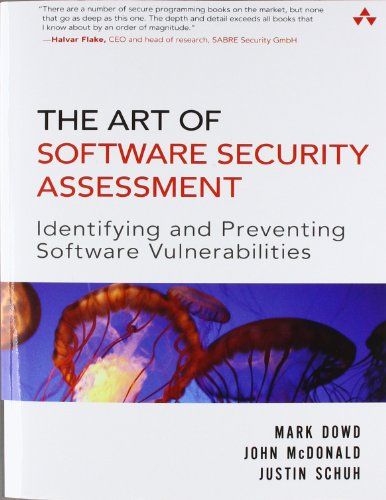
The Art of Software Security Assessment
Identifying and Preventing Software Vulnerabilities
The 1200-page reference on auditing C/C++ codebases for security: parsing complex memory and integer interactions, language pitfalls, and how vulnerabilities arise from interactions between layers.
As an Amazon Associate we earn from qualifying purchases. The link above is sponsored.
- Authors
- Mark Dowd,John McDonald,Justin Schuh
- Published
- 2006
- Publisher
- Addison-Wesley Professional
- Pages
- 1200
- Language
- English
Read this if
Auditors, vulnerability researchers, and developers of C/C++ codebases. The deepest book in print on reading code adversarially. Old, dense, and still unsurpassed.
Skip this if
Web developers, anyone working in memory-safe languages exclusively, or beginners with no C/C++ exposure. The book is a 1,200-page audit primer; nothing else competes for depth.
Key takeaways
- Vulnerability classes (memory corruption, integer issues, format strings, race conditions) arise from interactions between layers; the book teaches you to see the boundaries.
- The chapter on integer issues is the canonical reference; most public CVEs in C/C++ codebases through 2025 still trace back to patterns Dowd/McDonald/Schuh named here.
- The case studies (Apache, Postfix, Solaris, OpenSSL) make the abstractions concrete; reading them in order builds the auditor's eye nothing else does.
Notes
Read it in chunks alongside real code audits, not cover to cover. Pair with Hacking: The Art of Exploitation (Erickson) for the offensive side and with Designing Secure Software (Kohnfelder) for the defensive design view. The book pre-dates Rust adoption but the reasoning transfers cleanly to anywhere C/C++ still ships in 2026 (kernel, embedded, browser cores). The single most important book for vulnerability researchers.
What to read before
What to read before The Art of Software Security Assessment →Intermediate · 2021
Real-World Cryptography
David Wong's hands-on tour of the cryptographic primitives, protocols and pitfalls that show up in actual production systems, with deliberate attention to TLS, Noise, modern AEAD, and post-quantum.
Intermediate · 2021
Designing Secure Software
Loren Kohnfelder, the original PKI author, on how to weave security thinking through requirements, design, implementation and operations rather than bolt it on at the end.
Intermediate · 2014
Threat Modeling
Adam Shostack's practitioner-oriented introduction to threat modeling: STRIDE, attack trees, and how to fit the practice into a real software-development lifecycle.
What to read next
What to read after The Art of Software Security Assessment →Advanced · 2011
The Tangled Web
The deepest book ever written on the strange, accreted security model of the web browser.
Advanced · 2024
Windows Security Internals
Forshaw takes apart the Windows security model from the SRM and access tokens up through Kerberos, with live PowerShell you can run against your own machine. The most authoritative single source on how Windows actually decides who can do what.
Advanced · 2005
The Database Hacker's Handbook
Litchfield, Anley, Heasman, and Grindlay's exhaustive 2005 reference on attacking and defending Oracle, SQL Server, DB2, MySQL, PostgreSQL, Sybase, and Informix — the era when the database engine itself was the soft target.
Explore similar books
Alternatives to The Art of Software Security Assessment →Advanced · 2024
Windows Security Internals
Forshaw takes apart the Windows security model from the SRM and access tokens up through Kerberos, with live PowerShell you can run against your own machine. The most authoritative single source on how Windows actually decides who can do what.
Intermediate · 2021
Real-World Cryptography
David Wong's hands-on tour of the cryptographic primitives, protocols and pitfalls that show up in actual production systems, with deliberate attention to TLS, Noise, modern AEAD, and post-quantum.
Advanced · 2011
The Tangled Web
The deepest book ever written on the strange, accreted security model of the web browser.