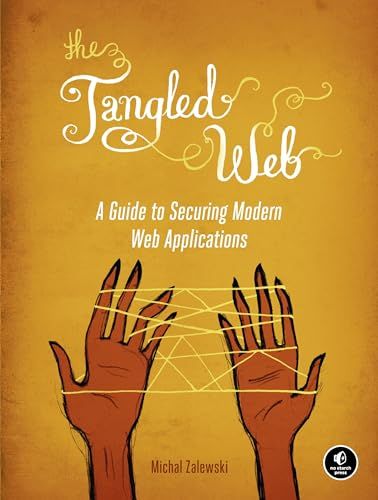
The Tangled Web
A Guide to Securing Modern Web Applications
The deepest book ever written on the strange, accreted security model of the web browser.
As an Amazon Associate we earn from qualifying purchases. The link above is sponsored.
- Authors
- Michal Zalewski
- Published
- 2011
- Publisher
- No Starch Press
- Pages
- 320
- Language
- English
Table of contents
18 chapters · 30 sectionsPart I: Anatomy of the Web
- 1
Security in the World of Web Applications
- 2
It Starts with a URL
- Uniform Resource Locator structure
- Reserved characters and percent-encoding
- Common URL schemes
- Resolution of relative URLs
- 3
Hypertext Transfer Protocol
- Basic syntax of HTTP traffic
- HTTP request types
- Server response codes
- Keepalive sessions
- Chunked data transfers
- Caching behavior
- HTTP cookie semantics
- HTTP authentication
- Protocol-level encryption and client certificates
- 4
Hypertext Markup Language
- Basic concepts behind HTML documents
- Understanding HTML parser behavior
- Entity encoding
- HTTP/HTML integration semantics
- Hyperlinking and content inclusion
- 5
Cascading Style Sheets
- 6
Browser-Side Scripts
- Basic characteristics of JavaScript
- Standard object hierarchy
- Script character encoding
- Code inclusion modes and nesting risks
- The living dead: VBScript
- 7
Non-HTML Document Types
- 8
Content Rendering with Browser Plug-ins
Part II: Browser Security Features
- 9
Content Isolation Logic
- Same-origin policy for the DOM
- Same-origin policy for XMLHttpRequest
- Same-origin policy for Web Storage
- Same-origin policy for cookies
- Plug-in security rules
- Coping with ambiguous or unexpected origins
- Other uses of the origin concept
- 10
Origin Inheritance
- 11
Life Outside Same-Origin Rules
- 12
Other Security Boundaries
- 13
Content Recognition Mechanisms
- 14
Dealing with Rogue Scripts
- 15
Extrinsic Site Privileges
Part III: A Glimpse of Things to Come
- 16
New and Upcoming Security Features
- 17
Other Browser Mechanisms of Note
- 18
Common Web Vulnerabilities
Prerequisites
You should already know what XSS, CSRF, and same-origin policy are. This book is for the second pass, not the first.
Read this if
Anyone who builds, attacks, or audits browser-based systems and wants to know why the rules are the way they are.
Skip this if
Beginners, Zalewski assumes you've already touched the surface and want the substrate. Start with PortSwigger Academy first.
Key takeaways
- The web's security model is not designed; it is excavated.
- Origins, schemes, and trust boundaries are the only real abstractions; everything else is a leaky negotiation.
- Specifications and reality diverge constantly, and the divergence is where bugs live.
Notes
Reads like an anthropologist's report on a culture they have lived inside. Older than half the platform features that matter today (no service workers, COOP/COEP, Trusted Types), but the older material is the soil all the new material grows from. The only book that explains why the browser is the way it is.
What to read before
What to read before The Tangled Web →Intermediate · 2023
Black Hat GraphQL
Aleks and Farhi on attacking GraphQL specifically: introspection abuse, batching, depth and complexity attacks, auth flaws, and the differences from REST that make GraphQL pentests their own discipline.
Intermediate · 2022
Hacking APIs
Corey Ball's structured approach to attacking REST and GraphQL APIs: enumeration, auth flaws, business logic, mass assignment, and the testing harness around them.
Intermediate · 2011
The Web Application Hacker's Handbook
The exhaustive reference for web app pentesting, comprehensive but increasingly a historical document.
What to read next
What to read after The Tangled Web →Advanced · 2006
The Art of Software Security Assessment
The 1200-page reference on auditing C/C++ codebases for security: parsing complex memory and integer interactions, language pitfalls, and how vulnerabilities arise from interactions between layers.
Advanced · 2005
The Database Hacker's Handbook
Litchfield, Anley, Heasman, and Grindlay's exhaustive 2005 reference on attacking and defending Oracle, SQL Server, DB2, MySQL, PostgreSQL, Sybase, and Informix — the era when the database engine itself was the soft target.
Intermediate · 2023
Black Hat GraphQL
Aleks and Farhi on attacking GraphQL specifically: introspection abuse, batching, depth and complexity attacks, auth flaws, and the differences from REST that make GraphQL pentests their own discipline.
Explore similar books
Alternatives to The Tangled Web →Intermediate · 2023
Black Hat GraphQL
Aleks and Farhi on attacking GraphQL specifically: introspection abuse, batching, depth and complexity attacks, auth flaws, and the differences from REST that make GraphQL pentests their own discipline.
Intermediate · 2022
Hacking APIs
Corey Ball's structured approach to attacking REST and GraphQL APIs: enumeration, auth flaws, business logic, mass assignment, and the testing harness around them.
Intermediate · 2011
The Web Application Hacker's Handbook
The exhaustive reference for web app pentesting, comprehensive but increasingly a historical document.