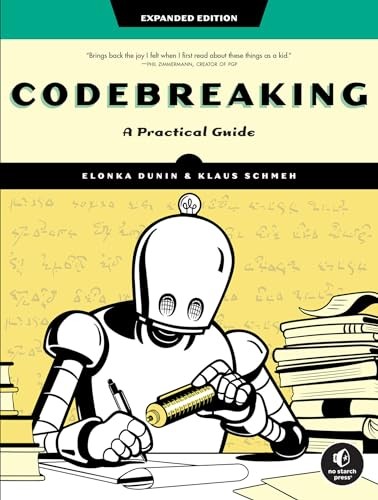
Codebreaking
A Practical Guide · Expanded Edition
Elonka Dunin and Klaus Schmeh teach classical cryptanalysis through real, unsolved ciphers, from 19th-century newspaper personal ads to wartime telegrams, using free tools like CrypTool 2.
As an Amazon Associate we earn from qualifying purchases. The link above is sponsored.
- Authors
- Elonka Dunin,Klaus Schmeh
- Published
- 2023
- Publisher
- No Starch Press
- Pages
- 488
- Edition
- Expanded Edition
- Language
- English
Read this if
Hobbyist codebreakers and security people who want the historical and puzzle-solving side of cryptography, not the mathematical theory. Dunin maintains the web's reference list of unsolved ciphers and Schmeh is the most-published cryptology author alive, so the case studies are the real, still-open ones.
Skip this if
Readers who want modern applied cryptography, algorithm design, or anything about securing systems; this is classical/historical cipher-breaking (substitution, polyalphabetic, transposition), not AES or TLS. Pair with Serious Cryptography or Cryptography Engineering for that side.
Key takeaways
- Teaches cryptanalysis on real, unsolved historical ciphers rather than textbook exercises, which keeps the puzzle-solving stakes genuine.
- CrypTool 2 and other free software get hands-on coverage, so the skills transfer to actually attacking a ciphertext, not just reading about it.
- Several of the book's case studies remain unsolved mysteries today; readers are explicitly invited to take a crack at them.
Notes
A lighter, puzzle-driven complement to the catalog's applied-cryptography titles (Serious Cryptography, Cryptography Engineering, Crypto Dictionary) — this is the history and hobbyist side of the field, not the engineering side. Good pairing with A Hacker's Mind for readers who like the "codes as artifacts of history" angle.
What to read before
What to read before Codebreaking →Beginner · 2021
Crypto Dictionary
Jean-Philippe Aumasson's alphabetical, opinionated reference on cryptographic terms, primitives, attacks and folklore. Snack-format companion to Serious Cryptography.
Beginner · 1999
The Code Book
A narrative history of cryptography from Caesar ciphers to public-key, told through the people and the wars that turned on broken codes. Still the best on-ramp to why crypto matters.
Intermediate · 2024
Serious Cryptography
Jean-Philippe Aumasson's working introduction to modern cryptography, written for engineers who need both intuition and enough mathematical depth to evaluate the choices a library is making for them.
What to read next
What to read after Codebreaking →Intermediate · 2024
Serious Cryptography
Jean-Philippe Aumasson's working introduction to modern cryptography, written for engineers who need both intuition and enough mathematical depth to evaluate the choices a library is making for them.
Beginner · 2021
Crypto Dictionary
Jean-Philippe Aumasson's alphabetical, opinionated reference on cryptographic terms, primitives, attacks and folklore. Snack-format companion to Serious Cryptography.
Intermediate · 1998
La science du secret
A lucid popular-science history of cryptography by Jacques Stern, one of France's most eminent cryptographers — from classical ciphers to public-key and the science of secrecy.
Explore similar books
Alternatives to Codebreaking →Beginner · 2021
Crypto Dictionary
Jean-Philippe Aumasson's alphabetical, opinionated reference on cryptographic terms, primitives, attacks and folklore. Snack-format companion to Serious Cryptography.
Intermediate · 2024
Serious Cryptography
Jean-Philippe Aumasson's working introduction to modern cryptography, written for engineers who need both intuition and enough mathematical depth to evaluate the choices a library is making for them.
Beginner · 1999
The Code Book
A narrative history of cryptography from Caesar ciphers to public-key, told through the people and the wars that turned on broken codes. Still the best on-ramp to why crypto matters.