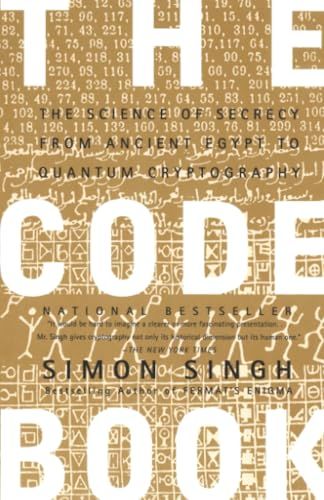
The Code Book
The Science of Secrecy from Ancient Egypt to Quantum Cryptography
A narrative history of cryptography from Caesar ciphers to public-key, told through the people and the wars that turned on broken codes. Still the best on-ramp to why crypto matters.
As an Amazon Associate we earn from qualifying purchases. The link above is sponsored.
- Authors
- Simon Singh
- Published
- 1999
- Publisher
- Anchor
- Pages
- 432
- Language
- English
Prerequisites
None. Singh teaches the math you need as he goes, no background assumed.
Read this if
Anyone curious how secrecy actually works and why it mattered, students, career-changers, defenders who want the history their tools inherit.
Skip this if
Engineers who want working crypto. This is history and intuition, not a reference, skip it if you need implementation detail or modern protocol specifics.
Key takeaways
- Most ciphers fall not to brute force but to human pattern and procedural sloppiness.
- Breaking Enigma was an industrial, organizational effort, not a lone-genius moment.
- Public-key cryptography solved the key-distribution problem that had constrained secrecy for millennia.
Notes
The book that makes cryptography feel inevitable rather than arcane, and Singh's Enigma and public-key chapters are still the clearest popular accounts written. It dates only where you'd expect, the quantum-crypto closing is now a period piece, but the historical spine is timeless. Give it to anyone who thinks crypto is just math they'll never need.
What to read before
What to read before The Code Book →Beginner · 2011
Kingpin
Kevin Poulsen's reconstruction of Max Butler's career — from white-hat consultant to running CardersMarket, the carding forum that consolidated the early-2000s underground — and the FBI investigation that finally took him down.
Beginner · 1989
The Cuckoo's Egg
Clifford Stoll's first-person account of investigating a 75-cent accounting discrepancy at LBNL that turned into a year-long pursuit of a KGB-paid intruder across early-internet networks.
Beginner · 2014
@War
Shane Harris on the entanglement of US military doctrine, the intelligence community, and private contractors after cyberspace was declared the fifth warfighting domain.
What to read next
What to read after The Code Book →Intermediate · 2024
Serious Cryptography
Jean-Philippe Aumasson's working introduction to modern cryptography, written for engineers who need both intuition and enough mathematical depth to evaluate the choices a library is making for them.
Intermediate · 1998
La science du secret
A lucid popular-science history of cryptography by Jacques Stern, one of France's most eminent cryptographers — from classical ciphers to public-key and the science of secrecy.
Intermediate · 2021
Real-World Cryptography
David Wong's hands-on tour of the cryptographic primitives, protocols and pitfalls that show up in actual production systems, with deliberate attention to TLS, Noise, modern AEAD, and post-quantum.
Explore similar books
Alternatives to The Code Book →Intermediate · 2024
Serious Cryptography
Jean-Philippe Aumasson's working introduction to modern cryptography, written for engineers who need both intuition and enough mathematical depth to evaluate the choices a library is making for them.
Beginner · 2011
Kingpin
Kevin Poulsen's reconstruction of Max Butler's career — from white-hat consultant to running CardersMarket, the carding forum that consolidated the early-2000s underground — and the FBI investigation that finally took him down.
Beginner · 1989
The Cuckoo's Egg
Clifford Stoll's first-person account of investigating a 75-cent accounting discrepancy at LBNL that turned into a year-long pursuit of a KGB-paid intruder across early-internet networks.