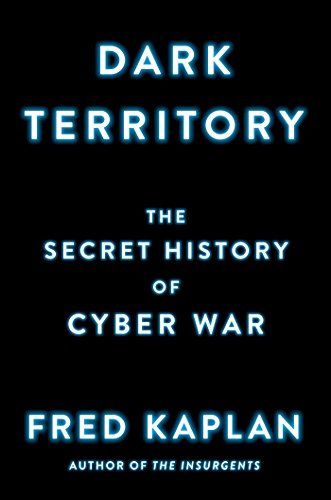
Dark Territory
The Secret History of Cyber War
Fred Kaplan's policy-side history of US cyber capability, from Reagan-era panic about WarGames to the institutional buildup of NSA's offensive arm and the political fights over its use.
As an Amazon Associate we earn from qualifying purchases. The link above is sponsored.
- Authors
- Fred Kaplan
- Published
- 2016
- Publisher
- Simon & Schuster
- Pages
- 352
- Language
- English
Read this if
Anyone who needs the political backstory of US cyber capability: how doctrine, contracting, and inter-agency turf wars shaped what NSA, CYBERCOM, and FBI Cyber actually do. The institutional history that operational books skip.
Skip this if
Practitioners wanting technical detail on specific operations. Kaplan is a Pulitzer-winning policy reporter; the depth is in the inter-agency politics, not the implementation.
Key takeaways
- US cyber capability grew in fits, not strategy: each major investment was driven by a specific embarrassment (Solar Sunrise, Moonlight Maze, Buckshot Yankee, OPM) rather than coherent doctrine.
- The civilian/military divide and the NSA-vs-FBI turf wars predict more about policy outcomes than any classified document the author had access to.
- Stuxnet was the apex of an institutional learning curve that started with Reagan watching WarGames; the book makes the line continuous.
Notes
Best paired with Sandworm (Greenberg) for the GRU continuity and with @War (Harris) for the contractor-side view. Kaplan's footnoting and source-naming is unusually rigorous for a trade-press book; read the endnotes. If you brief executives or boards on cyber risk, the book is required reading for the historical context that informs every present-day decision.
What to read before
What to read before Dark Territory →Beginner · 2014
@War
Shane Harris on the entanglement of US military doctrine, the intelligence community, and private contractors after cyberspace was declared the fifth warfighting domain.
Beginner · 2011
Kingpin
Kevin Poulsen's reconstruction of Max Butler's career — from white-hat consultant to running CardersMarket, the carding forum that consolidated the early-2000s underground — and the FBI investigation that finally took him down.
Beginner · 2019
Sandworm
Long-form journalism on the GRU's hacking operations, the best non-technical book on what state-level cyber actually looks like.
What to read next
What to read after Dark Territory →Beginner · 2014
@War
Shane Harris on the entanglement of US military doctrine, the intelligence community, and private contractors after cyberspace was declared the fifth warfighting domain.
Beginner · 2011
Kingpin
Kevin Poulsen's reconstruction of Max Butler's career — from white-hat consultant to running CardersMarket, the carding forum that consolidated the early-2000s underground — and the FBI investigation that finally took him down.
Beginner · 2019
Sandworm
Long-form journalism on the GRU's hacking operations, the best non-technical book on what state-level cyber actually looks like.
Explore similar books
Alternatives to Dark Territory →Beginner · 2014
@War
Shane Harris on the entanglement of US military doctrine, the intelligence community, and private contractors after cyberspace was declared the fifth warfighting domain.
Beginner · 2020
The Hacker and the State
Ben Buchanan's argument that state-on-state cyber operations are not deterrence-shaped (like nuclear) but signaling-shaped: countries use cyber to shape the environment, not to threaten escalation. Builds the case from declassified incidents.
Beginner · 2019
Sandworm
Long-form journalism on the GRU's hacking operations, the best non-technical book on what state-level cyber actually looks like.