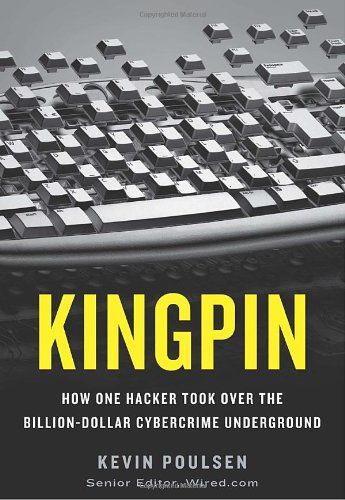
Kingpin
How One Hacker Took Over the Billion-Dollar Cybercrime Underground
Kevin Poulsen's reconstruction of Max Butler's career — from white-hat consultant to running CardersMarket, the carding forum that consolidated the early-2000s underground — and the FBI investigation that finally took him down.
As an Amazon Associate we earn from qualifying purchases. The link above is sponsored.
- Authors
- Kevin Poulsen
- Published
- 2011
- Publisher
- Crown
- Pages
- 288
- Language
- English
Read this if
Anyone interested in cybercrime as an economy rather than as a series of incidents. Poulsen, himself a former hacker turned journalist, has both the access and the technical fluency to make the carding-economy mechanics legible.
Skip this if
Readers wanting current ransomware-economy detail; the book is 2011 and pre-dates the modern affiliate / RaaS structure. The mechanics generalize, the actors don't.
Key takeaways
- Cybercrime markets are markets — they have liquidity, reputation, dispute resolution, and trust topology, and they fail in market-like ways.
- Most underground takedowns are won by HUMINT and OSINT inside the forums, not by exploitation; Butler's downfall was social.
- The book's pacing makes the carding economy legible without flattening the moral complexity of its inhabitants.
Notes
Pair with Spam Nation (Krebs) for the parallel email-criminal economy, with Tracers in the Dark (Greenberg) for the cryptocurrency-era successor, and with DarkMarket (Glenny) for the European cousin. The book is the gold standard cybercrime narrative of the pre-Bitcoin era and one of the best books on its subject in any field.
What to read before
What to read before Kingpin →Beginner · 2014
Spam Nation
Brian Krebs's investigative deep-dive into the Russian-speaking pharma-spam economy of the late 2000s — the affiliate networks, the rivalries, and the people who ran them.
Beginner · 2017
American Kingpin
A propulsive account of how Ross Ulbricht built the Silk Road dark-web drug empire as Dread Pirate Roberts, and how a handful of investigators across rival agencies finally unmasked him.
Beginner · 1999
The Code Book
A narrative history of cryptography from Caesar ciphers to public-key, told through the people and the wars that turned on broken codes. Still the best on-ramp to why crypto matters.
What to read next
What to read after Kingpin →Beginner · 2014
Spam Nation
Brian Krebs's investigative deep-dive into the Russian-speaking pharma-spam economy of the late 2000s — the affiliate networks, the rivalries, and the people who ran them.
Intermediate · 2010
Cybercriminalité
A practitioner's treatment of cybercrime law — offences, procedure, and the application of criminal law to digital crime — by a French magistrate specialised in the field.
Beginner · 2017
American Kingpin
A propulsive account of how Ross Ulbricht built the Silk Road dark-web drug empire as Dread Pirate Roberts, and how a handful of investigators across rival agencies finally unmasked him.
Explore similar books
Alternatives to Kingpin →Beginner · 2014
Spam Nation
Brian Krebs's investigative deep-dive into the Russian-speaking pharma-spam economy of the late 2000s — the affiliate networks, the rivalries, and the people who ran them.
Beginner · 2017
American Kingpin
A propulsive account of how Ross Ulbricht built the Silk Road dark-web drug empire as Dread Pirate Roberts, and how a handful of investigators across rival agencies finally unmasked him.
Beginner · 1999
The Code Book
A narrative history of cryptography from Caesar ciphers to public-key, told through the people and the wars that turned on broken codes. Still the best on-ramp to why crypto matters.