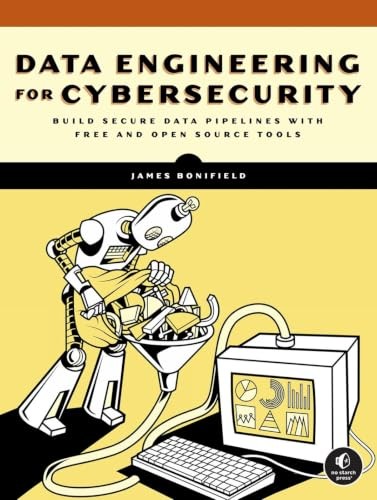
Data Engineering for Cybersecurity
Build Secure Data Pipelines with Free and Open-Source Tools
A decade-plus threat analyst teaches how to collect, normalize, enrich, and secure the telemetry (logs, events, metrics) that security teams depend on, using open-source tools like Filebeat, Logstash, Redis, Kafka, and Elasticsearch.
As an Amazon Associate we earn from qualifying purchases. The link above is sponsored.
- Authors
- James Bonifield
- Published
- 2025
- Publisher
- No Starch Press
- Pages
- 344
- Language
- English
Read this if
Detection engineers and SOC analysts who are tired of telemetry that doesn't organize itself and want to build the pipeline rather than just consume whatever the SIEM vendor provides. Covers collecting from Windows (Sysmon, PowerShell events), Linux (files, syslog), and network/security appliances, then transforming, securing, and automating with Ansible.
Skip this if
Readers looking for detection logic or threat hunting technique itself; this is the plumbing underneath those activities; not the analysis built on top of it. Also assumes comfort with Linux systems administration and basic scripting.
Key takeaways
- Treats telemetry as an engineering problem with its own lifecycle (collect, normalize, enrich, secure) rather than something a SIEM magically handles.
- Built entirely on free, open-source tooling (Filebeat, Logstash, Redis, Kafka, Elasticsearch), so the pipeline design is reproducible without a vendor contract.
- Automating deployment with Ansible is treated as part of the job, not an afterthought — the pipeline has to be maintainable, not just functional once.
Notes
The infrastructure layer underneath this catalog's detection and threat-intelligence titles (Intelligence-Driven Incident Response, Applied Network Security Monitoring, Network Security Through Data Analysis) — none of those books teach you to build the pipeline that feeds them, which is exactly this book's job. Pairs well with Malware Data Science for teams thinking about the full telemetry-to-detection-model pipeline.
What to read before
What to read before Data Engineering for Cybersecurity →Intermediate · 2011
The IDA Pro Book
Chris Eagle's deep manual on IDA Pro, the disassembler that defined a generation of reverse engineering. Useful even with Ghidra in the picture, since most malware-analysis literature still assumes IDA.
Advanced · 2015
Sécurité et espionnage informatique
A technical French guide to advanced persistent threats and cyber-espionage — how APT campaigns work, how to detect them, and how to defend — by one of France's APT specialists.
Intermediate · 2013
The Practice of Network Security Monitoring
Richard Bejtlich's NSM playbook: how to deploy collection sensors, validate that you actually see what you think you see, and build detection workflows around open-source tools.
What to read next
What to read after Data Engineering for Cybersecurity →Advanced · 2015
Sécurité et espionnage informatique
A technical French guide to advanced persistent threats and cyber-espionage — how APT campaigns work, how to detect them, and how to defend — by one of France's APT specialists.
Advanced · 2018
Practical Binary Analysis
Dennis Andriesse on the binary toolchain you can actually script: ELF internals, dynamic taint analysis, symbolic execution and instrumentation with concrete code-along examples.
Advanced · 2025
Cybersécurité et Malwares
Now in its 5th edition, the French-language reference for malware analysis by Sébastien Larinier and Paul Rascagnères, a well-known APT threat researcher, running from identification to Threat Intelligence across Windows, macOS, Linux, Android, and iOS.
Explore similar books
Alternatives to Data Engineering for Cybersecurity →Advanced · 2015
Sécurité et espionnage informatique
A technical French guide to advanced persistent threats and cyber-espionage — how APT campaigns work, how to detect them, and how to defend — by one of France's APT specialists.
Advanced · 2018
Practical Binary Analysis
Dennis Andriesse on the binary toolchain you can actually script: ELF internals, dynamic taint analysis, symbolic execution and instrumentation with concrete code-along examples.
Advanced · 2026
Dissecting the Dark Web
HUMAN Security's VP of Threat Intelligence tears down real malware-as-a-service offerings sold on dark web forums, chapter by chapter, from stealers and loaders to ransomware and living-off-the-land post-exploitation kits.