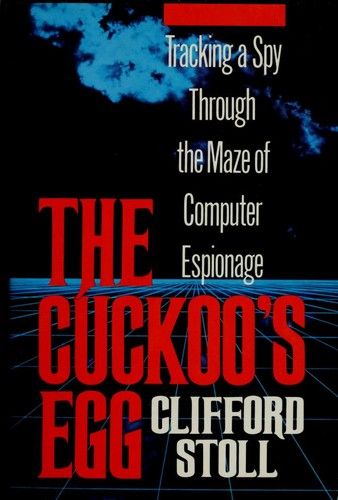
The Cuckoo's Egg
Tracking a Spy Through the Maze of Computer Espionage
Clifford Stoll's first-person account of investigating a 75-cent accounting discrepancy at LBNL that turned into a year-long pursuit of a KGB-paid intruder across early-internet networks.
As an Amazon Associate we earn from qualifying purchases. The link above is sponsored.
- Authors
- Clifford Stoll
- Published
- 1989
- Publisher
- Doubleday
- Pages
- 326
- Language
- English
Read this if
Anyone new to security who wants to feel why this work matters. The book that quietly recruited a generation into the field, written by an astronomer who became, almost reluctantly, the world's first detection engineer.
Skip this if
Readers expecting modern tradecraft. The protocols, tooling, and threat actors all date to the late 1980s. Treat it as a primary historical source, not a current operations manual.
Key takeaways
- Detection starts with anomaly curiosity, not with rules: the entire investigation begins because Stoll cares about a 75-cent error nobody else noticed.
- Cross-organisational coordination (FBI, NSA, CIA, telco, foreign intelligence) was already the bottleneck in 1986 and it's still the bottleneck today.
- The narrative invented the genre that Sandworm, Countdown to Zero Day, and Tracers in the Dark now occupy.
Notes
Read it in a week, on the couch, no laptop. Best paired with Sandworm (Greenberg) and Countdown to Zero Day (Zetter) for the modern continuity, and with Dark Territory (Kaplan) for the policy aftermath. The 2024 audiobook re-recording with Stoll narrating is excellent and adds his contemporary commentary. The cookies-Berkeley scene alone is worth the price of admission.
What to read before
What to read before The Cuckoo's Egg →Beginner · 2011
Kingpin
Kevin Poulsen's reconstruction of Max Butler's career — from white-hat consultant to running CardersMarket, the carding forum that consolidated the early-2000s underground — and the FBI investigation that finally took him down.
Beginner · 2019
Sandworm
Long-form journalism on the GRU's hacking operations, the best non-technical book on what state-level cyber actually looks like.
Beginner · 1999
The Code Book
A narrative history of cryptography from Caesar ciphers to public-key, told through the people and the wars that turned on broken codes. Still the best on-ramp to why crypto matters.
What to read next
What to read after The Cuckoo's Egg →Beginner · 2011
Kingpin
Kevin Poulsen's reconstruction of Max Butler's career — from white-hat consultant to running CardersMarket, the carding forum that consolidated the early-2000s underground — and the FBI investigation that finally took him down.
Beginner · 2019
Sandworm
Long-form journalism on the GRU's hacking operations, the best non-technical book on what state-level cyber actually looks like.
Beginner · 1999
The Code Book
A narrative history of cryptography from Caesar ciphers to public-key, told through the people and the wars that turned on broken codes. Still the best on-ramp to why crypto matters.
Explore similar books
Alternatives to The Cuckoo's Egg →Beginner · 2019
Sandworm
Long-form journalism on the GRU's hacking operations, the best non-technical book on what state-level cyber actually looks like.
Beginner · 2011
Kingpin
Kevin Poulsen's reconstruction of Max Butler's career — from white-hat consultant to running CardersMarket, the carding forum that consolidated the early-2000s underground — and the FBI investigation that finally took him down.
Beginner · 1999
The Code Book
A narrative history of cryptography from Caesar ciphers to public-key, told through the people and the wars that turned on broken codes. Still the best on-ramp to why crypto matters.