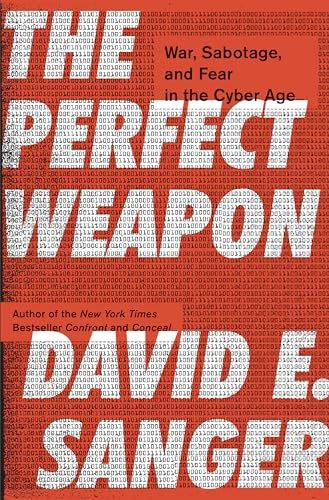
The Perfect Weapon
War, Sabotage, and Fear in the Cyber Age
The NYT national security correspondent's account of how cyber weapons became the tool states reach for short of war, from Stuxnet to Russian election interference. Strong on the politics and decision-making, light on the technology.
As an Amazon Associate we earn from qualifying purchases. The link above is sponsored.
- Authors
- David E. Sanger
- Published
- 2018
- Publisher
- Crown
- Pages
- 384
- Language
- English
Prerequisites
None. Sanger writes for the policy and general reader; no security background assumed.
Read this if
Readers who want the statecraft view of cyber, how it is debated in situation rooms and weighed against diplomacy. Pairs well with Sandworm and This Is How They Tell Me the World Ends.
Skip this if
Skip this if you want technical depth or fresh reporting; it is a strategic synthesis, and a US-centric one, that practitioners will already know in outline.
Key takeaways
- Cyber weapons are attractive precisely because they sit below the threshold of armed conflict, which makes deterrence and norms genuinely hard.
- The same offensive capabilities the US built and lost (the NSA leaks) came back as the raw material for global attacks.
- Decisions about cyber operations are political and improvised, not the product of settled doctrine.
Notes
Sanger's vantage point inside Washington is the book's strength and its limit: you get the deliberations and the ambivalence, but the technical and the non-American sides stay thin. It covers ground Sandworm and This Is How They Tell Me the World Ends also cover, and often less vividly, but it is the clearest single book on how governments actually think about offensive cyber. Worth reading for the policy frame even if the reporting feels familiar.
What to read before
What to read before The Perfect Weapon →Beginner · 2020
The Hacker and the State
Ben Buchanan's argument that state-on-state cyber operations are not deterrence-shaped (like nuclear) but signaling-shaped: countries use cyber to shape the environment, not to threaten escalation. Builds the case from declassified incidents.
Beginner · 2019
Sandworm
Long-form journalism on the GRU's hacking operations, the best non-technical book on what state-level cyber actually looks like.
Beginner · 2014
@War
Shane Harris on the entanglement of US military doctrine, the intelligence community, and private contractors after cyberspace was declared the fifth warfighting domain.
What to read next
What to read after The Perfect Weapon →Beginner · 2020
The Hacker and the State
Ben Buchanan's argument that state-on-state cyber operations are not deterrence-shaped (like nuclear) but signaling-shaped: countries use cyber to shape the environment, not to threaten escalation. Builds the case from declassified incidents.
Intermediate · 2018
Cyber
A strategic analysis of cyber conflict as permanent, sub-threshold warfare — and what France and Europe should do about it — by a former senior French strategist and a consultant.
Intermediate · 2024
Technopolitique
A sharp, current essay on how digital technology, AI and platform power have turned citizens into actors in a permanent informational and geopolitical conflict, by a prominent French tech-politics scholar.
Explore similar books
Alternatives to The Perfect Weapon →Beginner · 2020
The Hacker and the State
Ben Buchanan's argument that state-on-state cyber operations are not deterrence-shaped (like nuclear) but signaling-shaped: countries use cyber to shape the environment, not to threaten escalation. Builds the case from declassified incidents.
Beginner · 2019
Sandworm
Long-form journalism on the GRU's hacking operations, the best non-technical book on what state-level cyber actually looks like.
Beginner · 2023
A Hacker's Mind
Bruce Schneier extends the security-engineering frame of "hacking" to law, finance, politics, and tax: every rule-based system has exploitable seams, and the wealthy and powerful exploit them constantly.