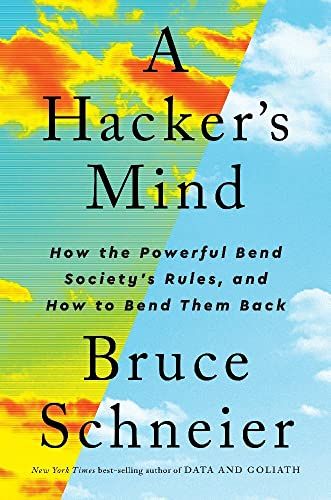
A Hacker's Mind
How the Powerful Bend Society's Rules, and How to Bend Them Back
Bruce Schneier extends the security-engineering frame of "hacking" to law, finance, politics, and tax: every rule-based system has exploitable seams, and the wealthy and powerful exploit them constantly.
As an Amazon Associate we earn from qualifying purchases. The link above is sponsored.
- Authors
- Bruce Schneier
- Published
- 2023
- Publisher
- W. W. Norton
- Pages
- 304
- Language
- English
Read this if
Security professionals who want to argue for security thinking outside computers, and policy-curious readers who already know Schneier's blog. The book makes vulnerability research, threat modeling, and patch dynamics legible to non-technical audiences in a way most authors cannot.
Skip this if
Readers looking for technical depth on cybersecurity itself. There is almost no code, no protocol detail, no incident dissection. The book is a generalization, not a primer; pair it with one of his earlier titles (Secrets and Lies, Liars and Outliers) if you want the security substrate.
Key takeaways
- Every system of rules has exploits; the question is who has the resources to find and use them, and law and finance are not exceptions.
- Patch cycles, vulnerability disclosure, and threat models are the right lenses for analyzing tax loopholes, regulatory capture, and political process — and Schneier makes the analogy rigorous, not cute.
- The asymmetry between attackers (power, money, time) and defenders (institutions, slow consensus) is the same in cyber as in policy; the book argues for governance designed around that asymmetry.
Notes
Pair with Click Here to Kill Everybody (Schneier) for the IoT-and-policy version of the same argument, and with The Hacker and the State (Buchanan) for the geopolitical layer. Schneier's blog (schneier.com) and Crypto-Gram newsletter are the ongoing companion. Useful gift for non-technical executives who keep asking what "thinking like a hacker" means.
What to read before
What to read before A Hacker's Mind →Beginner · 2020
The Hacker and the State
Ben Buchanan's argument that state-on-state cyber operations are not deterrence-shaped (like nuclear) but signaling-shaped: countries use cyber to shape the environment, not to threaten escalation. Builds the case from declassified incidents.
Beginner · 2018
The Perfect Weapon
The NYT national security correspondent's account of how cyber weapons became the tool states reach for short of war, from Stuxnet to Russian election interference. Strong on the politics and decision-making, light on the technology.
Beginner · 2021
Cyberjutsu
Ben McCarty maps declassified medieval ninja scrolls onto modern adversary tradecraft. More analogy-driven than technical, useful for security-program framing.
What to read next
What to read after A Hacker's Mind →Intermediate · 2024
Technopolitique
A sharp, current essay on how digital technology, AI and platform power have turned citizens into actors in a permanent informational and geopolitical conflict, by a prominent French tech-politics scholar.
Intermediate · 2010
Cybercriminalité
A practitioner's treatment of cybercrime law — offences, procedure, and the application of criminal law to digital crime — by a French magistrate specialised in the field.
Intermediate · 2021
RGPD et droit des données personnelles
A complete French manual on data-protection law under the GDPR and the 2018 loi Informatique et Libertés — obligations, rights and how to comply — by an engineer and doctor of law.
Explore similar books
Alternatives to A Hacker's Mind →Beginner · 2020
The Hacker and the State
Ben Buchanan's argument that state-on-state cyber operations are not deterrence-shaped (like nuclear) but signaling-shaped: countries use cyber to shape the environment, not to threaten escalation. Builds the case from declassified incidents.
Beginner · 2018
The Perfect Weapon
The NYT national security correspondent's account of how cyber weapons became the tool states reach for short of war, from Stuxnet to Russian election interference. Strong on the politics and decision-making, light on the technology.
Beginner · 2021
Cyberjutsu
Ben McCarty maps declassified medieval ninja scrolls onto modern adversary tradecraft. More analogy-driven than technical, useful for security-program framing.