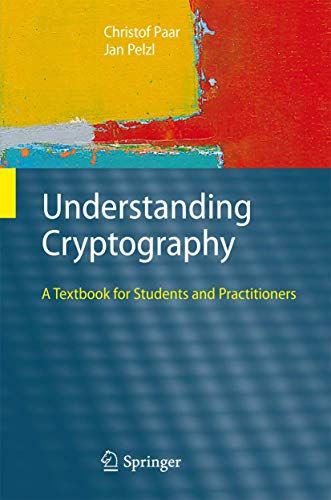
Understanding Cryptography
A Textbook for Students and Practitioners
A genuinely teachable intro to modern cryptography that derives the math instead of hand-waving it, covering symmetric and public-key primitives without drowning you in proofs.
As an Amazon Associate we earn from qualifying purchases. The link above is sponsored.
- Authors
- Christof Paar,Jan Pelzl
- Published
- 2010
- Publisher
- Springer
- Pages
- 372
- Language
- English
Prerequisites
Comfort with high-school-plus algebra and modular arithmetic. Paar builds the number theory you need, but you have to be willing to do the exercises.
Read this if
Engineers and students who want to actually understand AES, RSA, and ECC rather than just call a library, and who learn better from worked examples than from theorem-proof.
Skip this if
Skip this if you want a security-engineering how-to. It teaches the primitives, not protocol design, key management, or how things break in production.
Key takeaways
- The discrete logarithm problem and integer factorization are the two pillars under most deployed public-key crypto, and the book makes you compute with both.
- AES is presented as understandable finite-field arithmetic, not magic, which demystifies the most-used cipher on earth.
- Cryptographic security is about quantifying attacker effort, not about secrecy of the algorithm.
Notes
The rare crypto textbook you can hand to a motivated engineer and expect them to finish. Paar's companion video lectures make it close to a self-study course, and the worked examples are the best part. It stops exactly where the hard, messy parts of real-world crypto begin, so treat it as a foundation, not a destination.
What to read before
What to read before Understanding Cryptography →Intermediate · 2024
Serious Cryptography
Jean-Philippe Aumasson's working introduction to modern cryptography, written for engineers who need both intuition and enough mathematical depth to evaluate the choices a library is making for them.
Intermediate · 1998
La science du secret
A lucid popular-science history of cryptography by Jacques Stern, one of France's most eminent cryptographers — from classical ciphers to public-key and the science of secrecy.
Intermediate · 2026
Maîtriser la cryptographie d'aujourd'hui et de demain
A cryptography engineer specializing in information-system security mechanisms, who also teaches the subject, builds from cryptography's mathematical foundations up to today's post-quantum standards.
What to read next
What to read after Understanding Cryptography →Advanced · 2015
Sécurité informatique
A rigorous academic course on the foundations of security — cryptography, authentication, access control — with corrected exercises, from a team of well-known French and Swiss cryptographers.
Advanced · 2023
Exercices et problèmes de cryptographie
A rigorous problem book for learning cryptography — over 150 corrected exercises with course summaries, for L3/master/engineering students — by a French academic cryptographer.
Intermediate · 2024
Serious Cryptography
Jean-Philippe Aumasson's working introduction to modern cryptography, written for engineers who need both intuition and enough mathematical depth to evaluate the choices a library is making for them.
Explore similar books
Alternatives to Understanding Cryptography →Intermediate · 2024
Serious Cryptography
Jean-Philippe Aumasson's working introduction to modern cryptography, written for engineers who need both intuition and enough mathematical depth to evaluate the choices a library is making for them.
Intermediate · 2026
Maîtriser la cryptographie d'aujourd'hui et de demain
A cryptography engineer specializing in information-system security mechanisms, who also teaches the subject, builds from cryptography's mathematical foundations up to today's post-quantum standards.
Intermediate · 1998
La science du secret
A lucid popular-science history of cryptography by Jacques Stern, one of France's most eminent cryptographers — from classical ciphers to public-key and the science of secrecy.