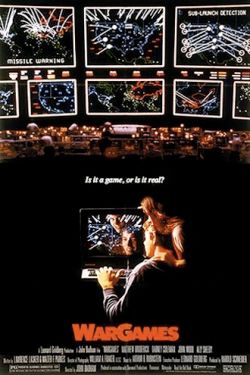
WarGames
A teenager dials into a back-end at NORAD and almost starts a nuclear war. The film that made the US government take computer security seriously and credited as inspiration for the 1986 Computer Fraud and Abuse Act.
- Directors
- John Badham
- Released
- 1983
- Writers
- Lawrence Lasker, Walter F. Parkes
- Runtime
- 114 min
- Language
- English
Available on
Watch this if
Anyone teaching the history of the field, or anyone who wants to see where the public's mental model of a hacker came from. Strong family viewing for security parents.
Skip this if
Anyone expecting accurate technical detail. War-dialing, BBSes, modem handshakes, dated. The film's lasting value is the premise, not the tradecraft.
Key takeaways
- The CFAA exists in part because Reagan watched this film and asked his Joint Chiefs whether it could really happen.
- Threat modeling against a curious teenager is harder than it sounds; this is the canonical fictional case study.
- The asymmetry between offense and defense was already a recognizable problem in 1983, the film names it before the field had vocabulary.
Notes
Pairs naturally with The Cuckoo's Egg (Stoll) and the early-internet history chapters of Dark Territory. Watch it once for entertainment, again as a primary-source artifact of how Cold War nuclear anxiety hybridized with computing in the public imagination. The line "the only winning move is not to play" reads less corny when you're staring at modern escalation dynamics.