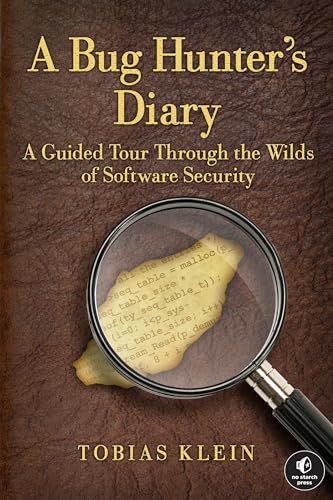
A Bug Hunter's Diary
A Guided Tour Through the Wilds of Software Security
Tobias Klein walks through seven real vulnerabilities he found and exploited, in the form of personal lab notes, what he tried, what failed, and what eventually shipped to vendors.
As an Amazon Associate we earn from qualifying purchases. The link above is sponsored.
- Authors
- Tobias Klein
- Published
- 2011
- Publisher
- No Starch Press
- Pages
- 200
- Language
- English
Read this if
Vulnerability researchers and aspiring bug hunters who want to feel what real research actually feels like. Klein's lab-notes format makes failure visible, which is the part the typical write-up genre hides.
Skip this if
Readers wanting modern web/API bug hunting. The book is binary-focused (browser, kernel, audio drivers) and from 2011; for current bug bounty workflow, read Real-World Bug Hunting and Bug Bounty Bootcamp instead.
Key takeaways
- Real vulnerability research is mostly hypothesis-and-failure; Klein's diary format teaches the resilience the field demands.
- Sample selection (which target, which feature, which bug class) is the highest-leverage choice; the book makes this explicit in a way most write-ups skip.
- Disclosure tradecraft (vendor coordination, patch tracking, advisory writing) is part of the work; the chapters on it are the calmest treatment in print.
Notes
Pair with Real-World Bug Hunting (Yaworski) for the modern web case studies and with The Shellcoder's Handbook for the binary-exploitation foundations. Klein's later work at Trail of Bits and the German vulnerability-research scene around him are the natural follow-up sources. The book is dated on specific bugs but evergreen on the way of working.
What to read before
What to read before A Bug Hunter's Diary →Beginner · 2021
This Is How They Tell Me the World Ends
Nicole Perlroth's reporting on the global zero-day market: how exploits get bought, by whom, and how the gray-then-black market shapes which vulnerabilities get fixed and which get hoarded.
Beginner · 2017
American Kingpin
A propulsive account of how Ross Ulbricht built the Silk Road dark-web drug empire as Dread Pirate Roberts, and how a handful of investigators across rival agencies finally unmasked him.
Beginner · 2011
Kingpin
Kevin Poulsen's reconstruction of Max Butler's career — from white-hat consultant to running CardersMarket, the carding forum that consolidated the early-2000s underground — and the FBI investigation that finally took him down.
What to read next
What to read after A Bug Hunter's Diary →Advanced · 2024
Windows Security Internals
Forshaw takes apart the Windows security model from the SRM and access tokens up through Kerberos, with live PowerShell you can run against your own machine. The most authoritative single source on how Windows actually decides who can do what.
Advanced · 2017
Attacking Network Protocols
James Forshaw, Project Zero veteran, on how to capture, parse, and break protocols from the wire up to the application layer, with a strong focus on building reusable analysis tooling.
Advanced · 2006
The Art of Software Security Assessment
The 1200-page reference on auditing C/C++ codebases for security: parsing complex memory and integer interactions, language pitfalls, and how vulnerabilities arise from interactions between layers.
Explore similar books
Alternatives to A Bug Hunter's Diary →Advanced · 2024
Windows Security Internals
Forshaw takes apart the Windows security model from the SRM and access tokens up through Kerberos, with live PowerShell you can run against your own machine. The most authoritative single source on how Windows actually decides who can do what.
Beginner · 2021
This Is How They Tell Me the World Ends
Nicole Perlroth's reporting on the global zero-day market: how exploits get bought, by whom, and how the gray-then-black market shapes which vulnerabilities get fixed and which get hoarded.
Intermediate · 2025
Metasploit
The second edition of the definitive No Starch guide to the Metasploit Framework, updated by the project's original maintainers and newer contributors for the modern Framework.