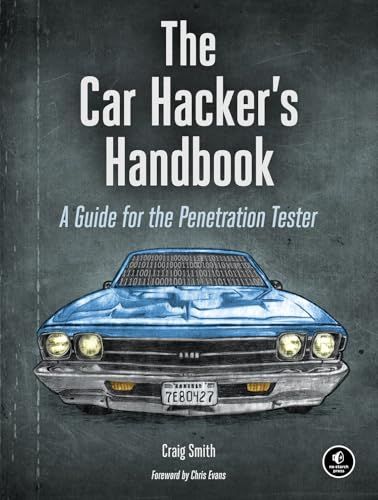
The Car Hacker's Handbook
A Guide for the Penetration Tester
Craig Smith's guide to automotive bus systems (CAN, LIN, FlexRay), ECUs, infotainment surfaces, and how to fuzz, trace and exploit modern vehicles.
As an Amazon Associate we earn from qualifying purchases. The link above is sponsored.
- Authors
- Craig Smith
- Published
- 2016
- Publisher
- No Starch Press
- Pages
- 304
- Language
- English
Read this if
Hardware hackers and security researchers approaching automotive targets. Smith covers CAN bus, ECU reverse engineering, infotainment attacks, and the lab tooling that makes vehicle research possible. The canonical entry point.
Skip this if
Pure software-security practitioners with no hardware bench. The book assumes you'll have an OBD-II adapter, an oscilloscope, and a target ECU within reach.
Key takeaways
- Modern vehicles are networks of dozens of ECUs talking over CAN; understanding the bus is the prerequisite for everything else.
- Infotainment systems are now the most accessible attack surface; the book's framing of the dual stack (Linux/Android infotainment + safety-critical ECUs) is the right model.
- Vehicle security research requires a real lab; the chapters on hardware setup and bus interception save weeks of reinvention.
Notes
Pair with Practical IoT Hacking (Chantzis et al) for the broader embedded context and with the OpenGarages.org community materials for current ongoing research. Smith's work on Open Garages gave the field its public-research culture; the book is the structured form. The 2016 publication date pre-dates many newer infotainment platforms; check current Black Hat / DEF CON Car Hacking Village talks alongside.
What to read before
What to read before The Car Hacker's Handbook →Intermediate · 2005
Reversing
The book that taught a generation how software actually looks once you strip away the source. Still the clearest on-ramp to thinking in assembly, even with dated tools.
Intermediate · 2011
The IDA Pro Book
Chris Eagle's deep manual on IDA Pro, the disassembler that defined a generation of reverse engineering. Useful even with Ghidra in the picture, since most malware-analysis literature still assumes IDA.
Intermediate · 2012
Practical Malware Analysis
Still the gold standard textbook for static and dynamic malware analysis on Windows.
What to read next
What to read after The Car Hacker's Handbook →Advanced · 2021
The Hardware Hacking Handbook
Jasper van Woudenberg and Colin O'Flynn (NewAE / ChipWhisperer) on real hardware attacks: bus sniffing, fault injection, side-channel power analysis, and the lab work that turns a black box into a known target.
Advanced · 2018
Practical Binary Analysis
Dennis Andriesse on the binary toolchain you can actually script: ELF internals, dynamic taint analysis, symbolic execution and instrumentation with concrete code-along examples.
Advanced · 2024
Evasive Malware
Kyle Cucci on the anti-analysis arms race: sandbox detection, anti-debug, anti-VM, packing, and the analyst-side tooling and tradecraft that get past those layers.
Explore similar books
Alternatives to The Car Hacker's Handbook →Advanced · 2021
The Hardware Hacking Handbook
Jasper van Woudenberg and Colin O'Flynn (NewAE / ChipWhisperer) on real hardware attacks: bus sniffing, fault injection, side-channel power analysis, and the lab work that turns a black box into a known target.
Intermediate · 2011
The IDA Pro Book
Chris Eagle's deep manual on IDA Pro, the disassembler that defined a generation of reverse engineering. Useful even with Ghidra in the picture, since most malware-analysis literature still assumes IDA.
Intermediate · 2005
Reversing
The book that taught a generation how software actually looks once you strip away the source. Still the clearest on-ramp to thinking in assembly, even with dated tools.