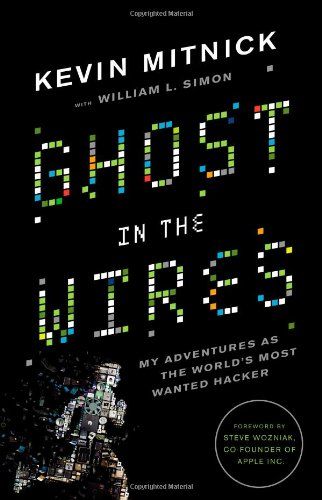
Ghost in the Wires
My Adventures as the World's Most Wanted Hacker
Kevin Mitnick's first-person account of his 1990s social-engineering and phone-system intrusions, foreword by Steve Wozniak. Self-promotional in tone but a primary source on a defining era.
As an Amazon Associate we earn from qualifying purchases. The link above is sponsored.
- Authors
- Kevin Mitnick,William L. Simon
- Published
- 2011
- Publisher
- Little, Brown and Company
- Pages
- 432
- Language
- English
Read this if
Anyone interested in the cultural history of hacking, the rise of social engineering as an art, or what 1990s telco infrastructure actually looked like from the inside. The genre's most famous memoir, written by the genre's most famous defendant.
Skip this if
Readers wanting balanced narration. Mitnick is the unreliable narrator of his own story; the persona is part of the brand. Pair with Jonathan Littman's The Fugitive Game or Tsutomu Shimomura's Takedown if you want adversarial perspectives.
Key takeaways
- Social engineering done well is indistinguishable from competence; the book is, almost incidentally, a textbook on rapport, pretexting, and operational tempo.
- Telco systems in the 1990s were authentication-by-obscurity at scale; the deeper lesson is how often that pattern still applies to modern infrastructure.
- The line between curiosity-driven exploration and federal felony is drawn by prosecutors, not technologists; the book is the canonical case study.
Notes
Best read alongside Tribe of Hackers, We Are Legion, and Steven Levy's Hackers (1984) for full cultural context. The audiobook (read by Ray Porter, with Mitnick narrating select chapters) is excellent. Mitnick's later work as a pentester at Mitnick Security is the practical sequel; this is the origin story.
What to read before
What to read before Ghost in the Wires →Beginner · 2011
Kingpin
Kevin Poulsen's reconstruction of Max Butler's career — from white-hat consultant to running CardersMarket, the carding forum that consolidated the early-2000s underground — and the FBI investigation that finally took him down.
Beginner · 1999
The Code Book
A narrative history of cryptography from Caesar ciphers to public-key, told through the people and the wars that turned on broken codes. Still the best on-ramp to why crypto matters.
Beginner · 1989
The Cuckoo's Egg
Clifford Stoll's first-person account of investigating a 75-cent accounting discrepancy at LBNL that turned into a year-long pursuit of a KGB-paid intruder across early-internet networks.
What to read next
What to read after Ghost in the Wires →Intermediate · 2018
Social Engineering
Christopher Hadnagy's broad procedural reference on social engineering as a discipline — recon, pretexting, elicitation, microexpressions, and the structured engagement model his consultancy operationalized.
Beginner · 2011
Kingpin
Kevin Poulsen's reconstruction of Max Butler's career — from white-hat consultant to running CardersMarket, the carding forum that consolidated the early-2000s underground — and the FBI investigation that finally took him down.
Beginner · 1999
The Code Book
A narrative history of cryptography from Caesar ciphers to public-key, told through the people and the wars that turned on broken codes. Still the best on-ramp to why crypto matters.
Explore similar books
Alternatives to Ghost in the Wires →Beginner · 2011
Kingpin
Kevin Poulsen's reconstruction of Max Butler's career — from white-hat consultant to running CardersMarket, the carding forum that consolidated the early-2000s underground — and the FBI investigation that finally took him down.
Beginner · 1999
The Code Book
A narrative history of cryptography from Caesar ciphers to public-key, told through the people and the wars that turned on broken codes. Still the best on-ramp to why crypto matters.
Beginner · 1989
The Cuckoo's Egg
Clifford Stoll's first-person account of investigating a 75-cent accounting discrepancy at LBNL that turned into a year-long pursuit of a KGB-paid intruder across early-internet networks.