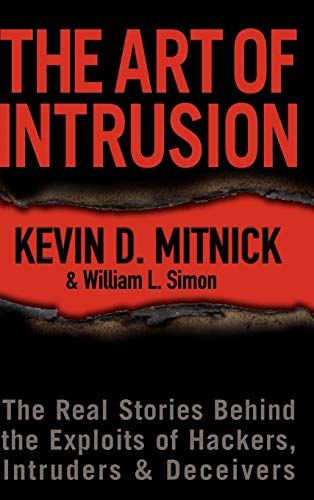
The Art of Intrusion
The Real Stories Behind the Exploits of Hackers, Intruders and Deceivers
Mitnick and Simon's follow-up to The Art of Deception: third-party stories from working hackers — casino slot exploits, prison-network breaches, post-9/11 intelligence ops — reconstructed and annotated by Mitnick.
As an Amazon Associate we earn from qualifying purchases. The link above is sponsored.
- Authors
- Kevin Mitnick,William L. Simon
- Published
- 2005
- Publisher
- Wiley
- Pages
- 288
- Language
- English
Read this if
Readers who liked The Art of Deception and want more case-study breadth, especially around physical-security pivots and improvised tradecraft. Underrated as a source of pretext patterns for awareness training: the casino chapter alone is worth the price.
Skip this if
Anyone needing current technique. The book is 2005 — Windows XP era — and the technology is incidental to the human stories anyway. Skim if you want; the value lives in the patterns, not the payloads.
Key takeaways
- Most successful intrusions are not single-vector — they are patient compositions of small advantages, and the book's structure makes that visible.
- The 'we got bored and tried it' chapters illustrate why curiosity is operationally distinct from skill, and why both matter.
- Insider stories like the prison and casino chapters are the closest most readers will get to seeing how a long-running campaign actually feels from the inside.
Notes
Pair with Kingpin (Poulsen) and Ghost in the Wires (Mitnick) for an adjacent narrative shelf, and with Cult of the Dead Cow (Menn) for the contemporaneous hacktivist context. Less essential than The Art of Deception, but a strong second course for the same reader. The casino-and-prison chapters are still the most retold stories in red-team training material twenty years later.
What to read before
What to read before The Art of Intrusion →Beginner · 2011
Kingpin
Kevin Poulsen's reconstruction of Max Butler's career — from white-hat consultant to running CardersMarket, the carding forum that consolidated the early-2000s underground — and the FBI investigation that finally took him down.
Beginner · 1999
The Code Book
A narrative history of cryptography from Caesar ciphers to public-key, told through the people and the wars that turned on broken codes. Still the best on-ramp to why crypto matters.
Beginner · 1989
The Cuckoo's Egg
Clifford Stoll's first-person account of investigating a 75-cent accounting discrepancy at LBNL that turned into a year-long pursuit of a KGB-paid intruder across early-internet networks.
What to read next
What to read after The Art of Intrusion →Beginner · 2011
Kingpin
Kevin Poulsen's reconstruction of Max Butler's career — from white-hat consultant to running CardersMarket, the carding forum that consolidated the early-2000s underground — and the FBI investigation that finally took him down.
Beginner · 1999
The Code Book
A narrative history of cryptography from Caesar ciphers to public-key, told through the people and the wars that turned on broken codes. Still the best on-ramp to why crypto matters.
Beginner · 1989
The Cuckoo's Egg
Clifford Stoll's first-person account of investigating a 75-cent accounting discrepancy at LBNL that turned into a year-long pursuit of a KGB-paid intruder across early-internet networks.
Explore similar books
Alternatives to The Art of Intrusion →Beginner · 2011
Kingpin
Kevin Poulsen's reconstruction of Max Butler's career — from white-hat consultant to running CardersMarket, the carding forum that consolidated the early-2000s underground — and the FBI investigation that finally took him down.
Beginner · 1999
The Code Book
A narrative history of cryptography from Caesar ciphers to public-key, told through the people and the wars that turned on broken codes. Still the best on-ramp to why crypto matters.
Beginner · 1989
The Cuckoo's Egg
Clifford Stoll's first-person account of investigating a 75-cent accounting discrepancy at LBNL that turned into a year-long pursuit of a KGB-paid intruder across early-internet networks.