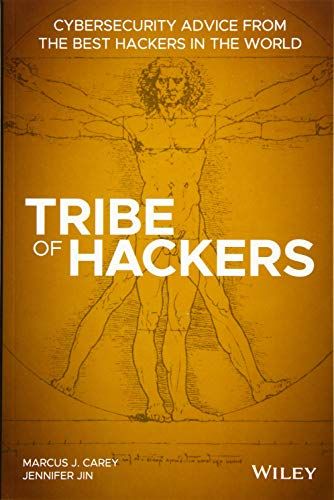
Tribe of Hackers
Cybersecurity Advice from the Best Hackers in the World
An interview anthology of practitioners answering the same set of career and craft questions, useful as a wide-angle view of how working security people actually think about the field.
As an Amazon Associate we earn from qualifying purchases. The link above is sponsored.
- Authors
- Marcus J. Carey,Jennifer Jin
- Published
- 2019
- Publisher
- Wiley
- Pages
- 400
- Language
- English
Read this if
Newcomers and career-shifters who want a wide-angle view of how working security people actually think. The interview format pulls signal across roles (red team, blue team, IR, AppSec, leadership) without committing to any single voice.
Skip this if
Experienced practitioners. The interviews are short and the same questions repeat; you've heard much of it at conferences. Specialists looking for technical depth should pick books in their lane instead.
Key takeaways
- The book's structure (same questions to many voices) is unusually useful for spotting consensus and disagreement; what most respondents agree on tends to be true.
- Career advice in security is unusually consistent across the field: communicate, document, ship, mentor, repeat. The book makes this visible.
- Diversity of voice across the panel (junior to CISO, offensive to defensive) is the value; pick interviews to match your current question, not read straight through.
Notes
Pair with Cybersecurity Career Master Plan or Hack-Proof Your Cyber Career for the structured-advice complement. The follow-up volumes (Tribe of Hackers Red Team, Blue Team, Security Leaders) narrow the focus and are usually better picks once you know your direction. Best skimmed and excerpted, not read end-to-end.
What to read before
What to read before Tribe of Hackers →Beginner · 2019
The Pragmatic Programmer
Thomas and Hunt's career-defining set of practical heuristics for writing software professionally — orthogonality, broken-windows, DRY, tracer bullets, and the underlying argument that craftsmanship is a posture, not a process.
Beginner · 2013
Hackers
A journalist's investigation into the hacker culture of digital resistance — Anonymous, WikiLeaks, Telecomix, the Chaos Computer Club — and the politics of a free Internet.
Beginner · 2017
La face cachée d'internet
A lively, expert tour of the Internet's hidden layers — hackers, the dark web, Tor, Anonymous, WikiLeaks, Bitcoin — that demystifies the jargon without dumbing it down.
What to read next
What to read after Tribe of Hackers →Beginner · 2019
The Pragmatic Programmer
Thomas and Hunt's career-defining set of practical heuristics for writing software professionally — orthogonality, broken-windows, DRY, tracer bullets, and the underlying argument that craftsmanship is a posture, not a process.
Beginner · 2013
Hackers
A journalist's investigation into the hacker culture of digital resistance — Anonymous, WikiLeaks, Telecomix, the Chaos Computer Club — and the politics of a free Internet.
Beginner · 2017
La face cachée d'internet
A lively, expert tour of the Internet's hidden layers — hackers, the dark web, Tor, Anonymous, WikiLeaks, Bitcoin — that demystifies the jargon without dumbing it down.
Explore similar books
Alternatives to Tribe of Hackers →Beginner · 2019
The Pragmatic Programmer
Thomas and Hunt's career-defining set of practical heuristics for writing software professionally — orthogonality, broken-windows, DRY, tracer bullets, and the underlying argument that craftsmanship is a posture, not a process.
Beginner · 2017
La face cachée d'internet
A lively, expert tour of the Internet's hidden layers — hackers, the dark web, Tor, Anonymous, WikiLeaks, Bitcoin — that demystifies the jargon without dumbing it down.
Beginner · 2013
Hackers
A journalist's investigation into the hacker culture of digital resistance — Anonymous, WikiLeaks, Telecomix, the Chaos Computer Club — and the politics of a free Internet.