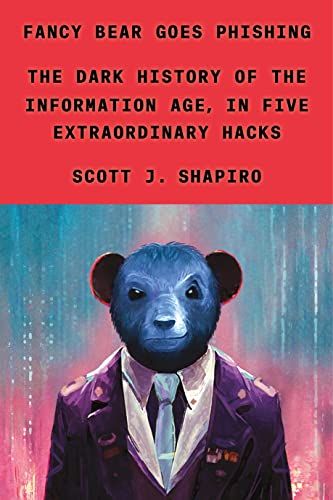
Fancy Bear Goes Phishing
The Dark History of the Information Age, in Five Extraordinary Hacks
Five famous hacks used as a way into the deeper question of why software is insecure at all, written by a Yale law professor who learned to code to write it. More a history and theory of vulnerability than a how-to.
As an Amazon Associate we earn from qualifying purchases. The link above is sponsored.
- Authors
- Scott J. Shapiro
- Published
- 2023
- Publisher
- Farrar, Straus and Giroux
- Pages
- 432
- Language
- English
Prerequisites
None. Shapiro builds up the technical ideas from scratch, which is part of the point and part of the problem.
Read this if
Readers who want the why behind the headlines, the conceptual and historical reasons computers can be broken into, told through memorable cases.
Skip this if
Practitioners after current technique or precise forensics. Skip this if a non-specialist explaining your field back to you, occasionally over-tidily, will grate.
Key takeaways
- Insecurity is not a series of accidents but a structural property of how general-purpose computers and the industry around them are built.
- The famous hacks are interesting less for their cleverness than for what they reveal about incentives, law, and human nature.
- Treating hacking as purely a technical problem misses the legal and economic machinery that keeps it profitable.
Notes
The framing, that insecurity is baked into the nature of computing rather than bolted on by careless engineers, is genuinely useful and well told. Be warned that technical readers have given it a mixed reception: the case histories are vivid, but the from-first-principles explanations of how code works can feel simplified or slightly off to people who do this for a living. Read it for the argument and the storytelling, not as a security reference.
What to read before
What to read before Fancy Bear Goes Phishing →Beginner · 2011
Kingpin
Kevin Poulsen's reconstruction of Max Butler's career — from white-hat consultant to running CardersMarket, the carding forum that consolidated the early-2000s underground — and the FBI investigation that finally took him down.
Beginner · 1999
The Code Book
A narrative history of cryptography from Caesar ciphers to public-key, told through the people and the wars that turned on broken codes. Still the best on-ramp to why crypto matters.
Beginner · 1989
The Cuckoo's Egg
Clifford Stoll's first-person account of investigating a 75-cent accounting discrepancy at LBNL that turned into a year-long pursuit of a KGB-paid intruder across early-internet networks.
What to read next
What to read after Fancy Bear Goes Phishing →Intermediate · 1998
La science du secret
A lucid popular-science history of cryptography by Jacques Stern, one of France's most eminent cryptographers — from classical ciphers to public-key and the science of secrecy.
Intermediate · 2026
Maîtriser la cryptographie d'aujourd'hui et de demain
A cryptography engineer specializing in information-system security mechanisms, who also teaches the subject, builds from cryptography's mathematical foundations up to today's post-quantum standards.
Intermediate · 2005
Reversing
The book that taught a generation how software actually looks once you strip away the source. Still the clearest on-ramp to thinking in assembly, even with dated tools.
Explore similar books
Alternatives to Fancy Bear Goes Phishing →Beginner · 2011
Kingpin
Kevin Poulsen's reconstruction of Max Butler's career — from white-hat consultant to running CardersMarket, the carding forum that consolidated the early-2000s underground — and the FBI investigation that finally took him down.
Beginner · 1999
The Code Book
A narrative history of cryptography from Caesar ciphers to public-key, told through the people and the wars that turned on broken codes. Still the best on-ramp to why crypto matters.
Beginner · 1989
The Cuckoo's Egg
Clifford Stoll's first-person account of investigating a 75-cent accounting discrepancy at LBNL that turned into a year-long pursuit of a KGB-paid intruder across early-internet networks.