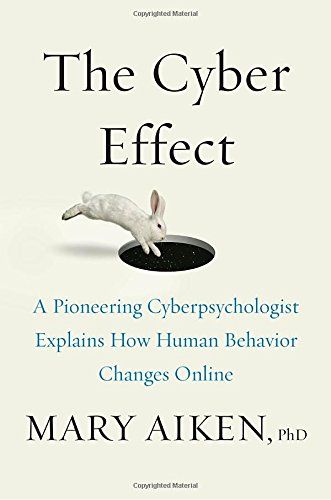
The Cyber Effect
A Pioneering Cyberpsychologist Explains How Human Behavior Changes Online
Mary Aiken's popular-science argument that online environments alter human behavior in measurable ways — escalation, disinhibition, time distortion — and that the security community underestimates the social-engineering surface this opens.
As an Amazon Associate we earn from qualifying purchases. The link above is sponsored.
- Authors
- Mary Aiken
- Published
- 2016
- Publisher
- Spiegel & Grau
- Pages
- 416
- Language
- English
Read this if
Readers in awareness, fraud, child-safety, or insider-threat work who want a frame for why social-engineering and online-radicalization attacks land. Also useful as a non-technical 'why does any of this matter' book for stakeholders who need a behavioural rather than technical framing.
Skip this if
Empirically rigorous readers; the book has been criticized for over-citing high-variance studies and conflating correlation with causation. Treat the argument as a useful hypothesis frame, not a research synthesis.
Key takeaways
- Online disinhibition is real and operationally relevant — it is the soil in which most social-engineering attacks grow.
- The book's strongest material is on the under-18 surface: the developmental case for why kids and teens are differently exposed than adult threat models assume.
- Take the empirical claims with a critical eye; the conceptual frame is more durable than any individual citation.
Notes
Read alongside more rigorous treatments — danah boyd's It's Complicated, Sherry Turkle's Reclaiming Conversation — for the academic counterweight. Pair with Social Engineering 2e (Hadnagy) for the operational mirror. The book's lasting value is opening the conversation about behavioral surface in cybersecurity; specific arguments deserve scrutiny but the topic emphatically deserves the attention.
What to read before
What to read before The Cyber Effect →Beginner · 2017
American Kingpin
A propulsive account of how Ross Ulbricht built the Silk Road dark-web drug empire as Dread Pirate Roberts, and how a handful of investigators across rival agencies finally unmasked him.
Beginner · 2011
Kingpin
Kevin Poulsen's reconstruction of Max Butler's career — from white-hat consultant to running CardersMarket, the carding forum that consolidated the early-2000s underground — and the FBI investigation that finally took him down.
Beginner · 2019
Sandworm
Long-form journalism on the GRU's hacking operations, the best non-technical book on what state-level cyber actually looks like.
What to read next
What to read after The Cyber Effect →Intermediate · 2011
A Bug Hunter's Diary
Tobias Klein walks through seven real vulnerabilities he found and exploited, in the form of personal lab notes, what he tried, what failed, and what eventually shipped to vendors.
Beginner · 2017
American Kingpin
A propulsive account of how Ross Ulbricht built the Silk Road dark-web drug empire as Dread Pirate Roberts, and how a handful of investigators across rival agencies finally unmasked him.
Beginner · 2011
Kingpin
Kevin Poulsen's reconstruction of Max Butler's career — from white-hat consultant to running CardersMarket, the carding forum that consolidated the early-2000s underground — and the FBI investigation that finally took him down.
Explore similar books
Alternatives to The Cyber Effect →Beginner · 2020
The Hacker and the State
Ben Buchanan's argument that state-on-state cyber operations are not deterrence-shaped (like nuclear) but signaling-shaped: countries use cyber to shape the environment, not to threaten escalation. Builds the case from declassified incidents.
Beginner · 2019
Sandworm
Long-form journalism on the GRU's hacking operations, the best non-technical book on what state-level cyber actually looks like.
Beginner · 2017
American Kingpin
A propulsive account of how Ross Ulbricht built the Silk Road dark-web drug empire as Dread Pirate Roberts, and how a handful of investigators across rival agencies finally unmasked him.